Sherif E Gabriel, PhD
| About | Research | Expertise | Biosketch | Personnel | Contact |
![]() |
| Bioelectrics of rectal biopsy tissue in Ussing chambers. |
About the Gabriel Lab
Dr. Gabriel's research focuses primarily on molecular regulation of ion transport in the airway and the gastrointestinal tract. The pulmonary airway surface is lined with a thin layer of liquid that is of primary importance in lung defense. It is well known that absorption and secretion of ions across the airway epithelium is responsible for maintaining the correct composition and volume of the airway surface liquid. What is not well known is i) the molecular identity of the channels and transporters responsible for this process, and ii) the mechanisms of regulation that coordinate the homeostasis of the pulmonary airway surface liquid.
It is generally accepted that airway epithelial cells are capable of both electrolyte absorption and secretion and that the net balance between these ion transport processes controls the movement of fluid by osmotic pressures. The ion channels lining the airway and colonic lumen constitute the rate-limiting step for both secretion and absorption. The basic route for Na+ absorption across the airway epithelium involves Na+ entry at the apical membrane via the Epithelial Na+ Channel (ENaC). Under conditions where Cl- secretion occurs (fetal liquid secretion), several Cl- channels are proposed to be involved including the cystic fibrosis transmembrane conductance regulator (CFTR- a cAMP-regulated Cl- channel), transmembrane protein 16a (TMEM- a calcium-activated Cl- channel), and bestrophin-2 (Best2- a candidate calcium-activated Cl- channel, and mediator of bicarbonate transport in murine colonic mucosa).
[top]
Research Focus
![]() |
![]() |
| Tmem16a wildtype and knockout littermates. | The oocytes of the Axolotl are used in voltage- clamp protocols. |
The long-term research interest of the laboratory focuses on the ion transport of these channels and involves several ongoing projects:
- Unveiling the functional significance of CaCCs, particularly TMEM16a, during development of the murine lung and the role
- they play in the adult airway.
- Determining the contribution of TMEM16a to CaCC activity and lung liquid secretion during fetal development.
- Understanding how TMEM16a and Bestrophin2 coordinately mediate the CaCC activity of the murine airway epithelium.
- Evaluating the expression of CaCC’s in the embryo, neonate, and adult mouse airway.
- Understanding the role of CFTR as a regulator of other ion channels.
- Determining the molecular interaction between ion channels and the mechanisms for coordinated regulation of channels.
- Understanding the role of ion transport in disease pathogenesis, in particular cystic fibrosis.
Expertise and Techniques
The laboratory uses a variety of molecular biology and electrophysiological techniques to address questions concerning colonic and airway fluid homeostasis. Molecular biology skills employed range from simple PCR, quantitative PCR, and RT-PCR, to Southern, Northern, Western and Southwestern blotting. Microscopic dissection of mouse embryonic lung and trachea isolation, explant culture, and generation of mouse trachea primary cells requires technical expertise. Several electrophysiological techniques are routinely employed to assess the function of candidate channels and regulators including, patch clamp (single channel and whole cell), transepithelial Ussing chamber voltage clamp protocols, and 2-electrode Xenopus and Axolotl oocyte voltage clamp protocols.
![]() |
|
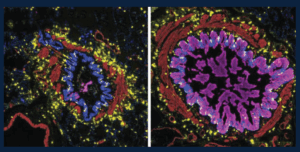
Explanted TMEM16a Distal Lung (left) and Trachea (right) |
[top]
Biosketch
Dr. Sherif E Gabriel, PhD, Associate Professor of Pediatrics, Cystic Fibrosis Center Correction Core Director
Education and Positions
1984 University of Saskatchewan, Saskatoon, B.Sc. Biochemistry
1990 University of Saskatchewan, SaskatoonPh.D., Biochemistry
1984 - 1990 Teaching Assistant, Introductory Biochemistry, University of Saskatchewan
1987 - 1990 Lecturer, Biochemistry for Veterinary Students, University of Saskatchewan
1989 - 1990 Lecturer, Gastrointestinal Physiology for Graduate Students, University of Saskatchewan
1991 - 1993 Postdoctoral Research Associate, Division of Pulmonary Medicine, UNC at Chapel Hill
1993 - 1994 Research Associate, Division of Pulmonary Medicine, UNC at Chapel Hill
1994 - 2000 Research Assistant Professor, Division of Pulmonary Medicine & Allergy, Department of Pediatrics, University of North Carolina at Chapel Hill
2001-present Associate Professor, Division of Pulmonary Medicine & Allergy, Department of Pediatrics, University of North Carolina at Chapel Hill
Professional Societies and Teaching Activities
American Physiological Society
Center for Gastrointestinal Biology and Disease; University of North Carolina & North Carolina State University
Resonsible for several hours of directed teaching in a classroom setting since 1987, including ~6 lecture hours/sememster of applied biochemistry to first year DVM students at the University of Saskatchewan (1987-1990); 9 lecture hours/ semester of teaching to physiology graduate students (M.Sc. & Ph.D.) at the University of Saskatchewan (1989-1990).
Directed lectures to Students/Fellows/Residents (1993- current):
1. School of Pharmacy, College of Pharmacy, CampbellUniversity, Buies Creek, North Carolina. September 16, 1993. 2 hour lecture “Cystic Fibrosis and the structure and function of CFTR.”
2. School of Pharmacy, College of Pharmacy, CampbellUniversity, Buies Creek, North Carolina. November 2, 1994. 2-hour lecture “Cystic Fibrosis and a possible heterozygote advantage.”
3. Physiology 225 Molecular Mechanisms of Disease, Dept. of Physiology, School of Medicine, University of North Carolina, Chapel Hill, NC. 1.5 hour lecture. February 24, 2000.
4. Physiology 225 Molecular Mechanisms of Disease, Dept. of Physiology, School of Medicine, University of North Carolina, Chapel Hill, NC. 1.5 hour lecture. February 11, 1999.
5. Basic Science in Medicine Seminar Series: "Working with DNA" restriction enzymes, plasmids, cloning, transfection, and using cloning in medicine. Dept. of Pediatrics, UNC. 2 hour lecture. Sept 29, 2000.
6. 2007 Core Curriculum for Pediatric Fellows. Department of Pediatrics. University of North Carolina, Chapel Hill, NC. 2 hour lecture "Starting out in research". August 15, 2006.
7. Ongoing opportunities to directly teach students working in my laboratory. Mentoring undergraduate students, graduate students, medical students, post-doctoral fellows and MD fellows during the development of their research careers.
Book Chapters and Invited Reviews
S.E. Gabriel and R.C. Boucher, 1996. Ion Channels. The Lung: Scientific Foundations, (2nd edition), 305-318. Editor Peter J. Barnes. Raven Press.
B.R. Grubb and S.E. Gabriel, 1997. Gene-targeted mouse models of cystic fibrosis; Effects on gastrointestinal physiology. American Journal of Physiology:Gastrointestinal, Liver Physiology, 273:G258-266.
S.E. Gabriel, 2002. Calcium activated Cl- channels in airway epithelium. Ca2+ Activated Cl- channels, Current Topics in Membranes. 53:193-207. Editor Catherine Fuller. Academic Press.
S.B. Shears, L. Yang, S.E. Gabriel and C.M.P. Riberio, 2004. Is Intervention in Inositol Phosphate Signaling a Useful Therapeutic Option for Cystic Fibrosis? Advances in Experimental Medicine and Biology: Defects of Secrtion in Cystic Fibrosis. 558:103-114. Editor Carsten Schultz. Springer.
[top]
Biosketch
Nancy Quinney, Research Specialist, Cystic Fibrosis Center Correction Core Manager
Education and Positions
B.S. Biology, St. Andrew’s Presbyterian College-1990
B.A. Chemistry, St. Andrew’s Presbyterian College-1990
2005-Present Research Specialist- UNC-CH, Cystic Fibrosis Center
2000-2005 Research Specialist- UNC-CH, Lineberger Cancer Center, Dept. of Immunology and Microbiology
1997-2000 Research Specialist and Assistant IVF Coordinator, UCLA, OB/GYN Reproductive Endocrinology and Infertility
1994-1997 Research Specialist- Medical University of South Carolina, Hollings Cancer Center
1992-1997 Research Specialist- Medical University of South Carolina, OB/GYN Reproductive Endocrinology and Infertility
1990-1992 Cell Culture Technician- Johns Hopkins Medical Institution, Immunogenetics
1987-1988 Teaching Assistant, Environmental Perspectives, St. Andrews Presbyterian College
[top]
Personnel
![]() |
|
| Dr. Sherif E Gabriel, Associate Professor of Pediatrics | Nancy Quinney, Research Specialist and Correction Core Manager |
Contact Information
6013 Thurston-Bowles BldgThe University of North Carolina at Chapel Hill
Campus Box #7248
Chapel Hill, NC 27599
Phone: (919) 966-7059
Fax: (919) 966-5178
Email: sgabriel@med.unc.edu
Email: quinney@email.unc.edu
[top]