
Cell Biology of Pulmonary Epithelia
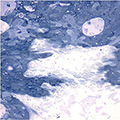
The UNC CF Center has an extensive supply of well-characterized human airway epithelial culture preparations. Indeed, the Center has a stock of more than 200 individual subject-derived upper (nasal) and lower airway (tracheobronchial) culture stocks from normal subjects, CF subjects, and subjects with COPD. These cultures can be grown in a variety of systems, most typically our air-liquid interface system (see Figure 1).
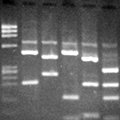
More recently, the CF Center has extended its cell purification/preparation capacities to other cell types within the lung. Consequently, we now have available stocks of human alveolar type II cells (Figure 2) and human pulmonary endothelial cells (see Figure 3). Upon request, we also have the capability of isolating human AT1 cells for specific studies.
![]() | ![]() |
|---|---|
| Figure 1. Human lung primary bronchial epithelial cells in air liquid interface cultures. The cells were prepared for histology using perflurocarbon-OsO4 to preserve the apical periciliary layer and overlying mucus. See full-size image... | Figure 2. Human lung primary alveolar type II cells. A. Freshly isolated cells stained for SPC (ii) and Aqp3 (iii). B. Cells at air-liquid interface. C,D. PCR for gene expression. See full-size image... |
![]() |
![]() |
| Figure 3. Human lung primary microvascular endothelial cells. Greater than 98% are positive for CD31 and the cells make tight monolayers suitable for permeability and transport studies. See full-size image... | |
[top]
The Cell Biology Core has the capacity to produce growth-extended cells. Such approaches include novel "immortalizing" genetic approaches, which produce cells with greatly extended growth capacity and good preservation of phenotypic structure and function (see Figure 4). In addition, more recent techniques, including fibroblast feeder cells and "Y compounds," have been used to growth-extend both human airway epithelial cells and alveolar epithelial cells, and are available upon request.
![]() |
|---|
| Figure 4. Novel growth enhanced human primary bronchial epithelial cells. These cells (3 normal and 3 CF donors) are capable of pseudostratified mucociliary differentiation after repeated passaging and are particularly useful for testing and applying genetic manipulation strategies. |
Inquiries
Questions? If you are interested in learning more about how the UNC CF Center can help further your research, or if you are interested in collaborating with us, please contact our CF Center Director, Dr. Richard Boucher:
7011 Thurston-Bowles Bldg.
The University of North Carolina at Chapel Hill
Campus Box #7248
Phone: (919) 966-1077
Fax: (919) 966-5178
Email: richard_boucher@med.unc.edu
[top]