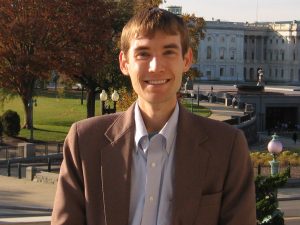
Chris Smith

Chris Smith has been a part of the NBIO Curriculum since 2009.  His research on decision making proves Chris to be hard at work, whether it be during the day, evening, or on weekends.  Read below to find out what Chris has been up to, in and out of the lab!

NBIO: What does your current research focus on?

CS: My research focuses on understanding the neurobiology of Now versus Later decision making behavior. Specifically, I utilize a behavioral “delay discounting” task which asks human participants to choose between a smaller, sooner reward and a larger later one. My advisor, Dr. Charlotte Boettiger, has shown previously that adults with an alcohol abuse disorder history are more likely to choose “Now” over “Later” in this particular task.

Behavioral data I have obtained over the past few years using our delay discounting task shows that young adults (ages 18-21) are more likely to choose the smaller, sooner reward versus adults with no substance abuse disorder OR heavy alcohol use behavior. However, adults who consume alcohol at a high rate seem to display a tendency to choose the smaller sooner reward that characterizes abstinent alcoholic adults. These findings suggest to us that brain maturation in the early to mid twenties may lead to a tendency to choose the more advantageous larger, delayed reward in our task and that this natural developmental trend is hindered in heavy alcohol users that have not yet become dependent on alcohol.

As earlier work with our decision making task implicated a role of prefrontal cortical dopamine signaling in Now/Later choice behavior, we are also investigating the impact of various genetic polymorphisms associated with dopamine signaling on this behavior.

This more mechanistic understanding of Now/Later decision making behavior may offer insight into methods to reduce Now choice biases that are often associated with drug addiction. Now bias is thought to potentiate drug self administration in the face of negative consequences as it manifests itself as favoring the short-term benefits of a drug (immediate stress relief/positive feeling of euphoria shortly after taking the drug) despite knowledge of the long term negative consequences of drug taking behavior.

NBIO: What type of work in the lab does this entail? Does it require a great amount of work outside the lab?

CS: I have been collecting behavioral performance data on human subjects completing our delay discounting task in both the lab and a functional magnetic resonance imaging (fMRI) scanner at UNC’s Biomedical Research Imaging Center (BRIC). We can quantify participants’ choice behavior in our task and determine if it relates to drug use, demographic, or genetic variables of interest to us. In the fMRI data, we can localize task-dependent brain regions associated with Now/Later choice behavior and determine if the brain structures functionally engaged in the task differ based on different between-subject measures (age, drinking behavior, genetics, etc…).

NBIO: What kind of hours does your research require? Can you explain a typical day in the lab?

CS: Working with human subjects requires a researcher to be flexible. I run subjects through our behavioral task whenever they are able to come in to the lab. Sometimes this includes evenings, weekends, etc…

A typical lab day involves inputting and processing behavioral and demographic data collected from subjects, recruiting and running subjects through the behavioral tasks we use in the lab either in our lab space or at the BRIC fMRI scanner, as well as the occasional processing and preparation of genetic samples for analyses of polymorphisms of interest to us.

NBIO: What are your plans following your time spent at UNC?

CS: I hope to gain further experience in neuroimaging techniques as an academic post doctoral fellow. I plan to explore opportunities to combine fMRI and positron emission tomography (PET) measures to better understand the role of neurotransmitters such as dopamine in decision making behavior.

PET is a powerful tool to help us understand how dopamine signaling in the brain may relate to human behavior as it allows for a quantification of dopamine receptor expression levels, among other neurotransmitters, by using radio-labeled receptor ligands specific for particular types of receptors.

NBIO: During your time at UNC, what is the most interesting event/activity your research/field of study has allowed you to be a part of?

CS: I have been able to attend a few intensive fMRI courses held at the University of Michigan and University of California, Los Angeles. These experiences have allowed me to meet and learn from many experts in the field of fMRI data collection, processing, and analysis. I have also been able to make contacts with students from across the United States who are interested in using neuroimaging techniques to better understand human cognition. These colleagues will serve as valuable resources for me as I move forward with my academic carrier. 

NBIO: When you’re not in the lab/doing research, what types of activities do you enjoy doing?

CS: I enjoy photography, reading, and watching sporting events in my spare time.