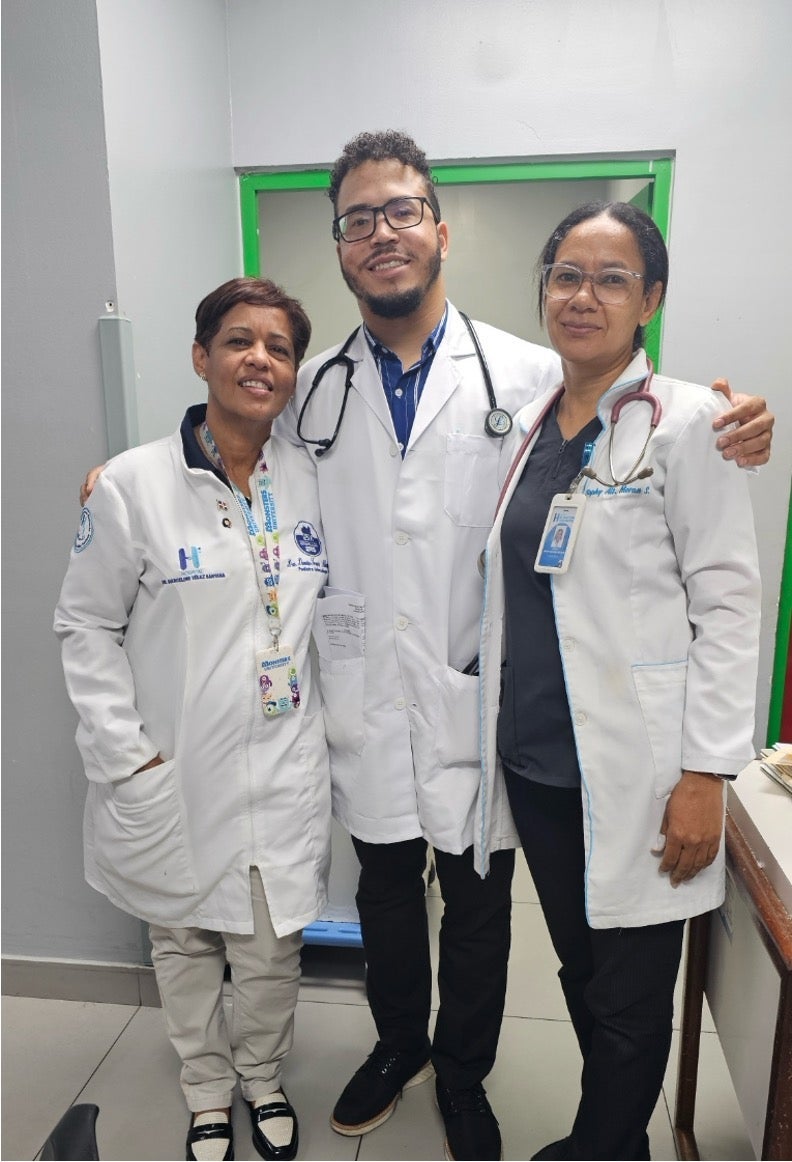
As a child, Jesus Viña Moreno spent countless hours at Hospital General Regional Dr. Marcelino Velez Santana in Santo Domingo, Dominican Republic. His mother completed her residency there, often bringing him along.
This past summer, Viña Moreno returned to those same halls, not as a visitor, but as a medical student from the UNC School of Medicine. Through the Office of Global Health Education in the Institute for Global Health and Infectious Diseases, he spent five weeks in the Dominican Republic, building clinical skills and reconnecting with a place that shaped his earliest memories.
“I have feelings for the place, so it felt natural for me to go back,” Viña Moreno said. “Seeing all the nurses and others who knew me, they’d say, ‘Oh, my gosh. You’re so tall now and you have a beard!’ They would hug me. It brought back those childhood memories.”
But not all of those memories were joyful. In the seventh grade, Viña Moreno was hospitalized there with dengue fever. His condition worsened unexpectedly, and he was transferred to a larger hospital. Still, his original physician, Dr. Dania Torres, continued overseeing his care.
There were some dire moments, but Viña Moreno ultimately made a full recovery largely because of Dr. Torres.
“She was one of the main reasons why I’m still here breathing,” Viña Moreno said.
This summer’s return also brought a reunion. Though Dr. Torres now serves as coordinator of the hospital’s Maternal and Child Unit, she made time to check in with Viña Moreno, asking about his experience and life in the United States.
“It was amazing — honestly, heartwarming — to see her,” Viña Moreno said. “Seeing the difference in roles where I went in the first time as a child and now I was there as someone closer to being a doctor, that felt gratifying.”
During his rotation, Viña Moreno focused on the areas he hoped to grow as a medical student, especially the nerves he felt when interacting with patients. On the internal medicine floor, he checked patients’ vitals, performed EKGs, and presented information to the residents and attendings. On more than one occasion, he helped save lives by alerting staff to deteriorating conditions or assisting with CPR.
The nerves he had of interacting with patients vanished.
“The patients loved me,” Viña Moreno said. “I would just go and talk to them. They would call me Dr. Viña. They knew I was just a student, but it’s tradition there.”
Now back in Chapel Hill for his second year of medical school, Viña Moreno says the trip gave him exactly what he needed: confidence.
“I’ve struggled all my life with imposter syndrome,” Viña Moreno said. “Even though I think ‘I’m good. I’m ready to do this. It will be great,’ there is a disconnect in what I know and how I feel. So right now, I feel much more confident in my abilities. That’s a big one.”
The trip also allowed him to use medical Spanish daily, a key component of his participation in the Comprehensive Advanced Medical Program of Spanish (CAMPOS), and it deepened his interest in neurology. He’s already applying what he saw abroad to his coursework.
“For example, I saw a lot of brain hemorrhages,” Viña Moreno said. “We’re studying strokes now, so I can say, ‘I remember seeing two or three patients with this hemorrhagic stroke and this is how they presented.’ That’s more memorable than reading the Bricks or watching a YouTube video. I can relate to the information much better now.”
Viña Moreno received support for the trip from an alumni donor through the Jeffrey L. Houpt Loyalty Fund Enrichment Endowment. He’s grateful for the opportunity and encourages other medical students to explore global health experiences.
“It’s a really great experience,” Viña Moreno said. “I recommend anyone over the summer — just go abroad, put yourself out there, and try to learn and experience new things. It was lovely.”
To help support future SOM student global health programs, donate at: www.unchf.org/globalmeded