Services and Rates
Use the link to book an appointment for consultation and research support.
High Throughput Sequencing
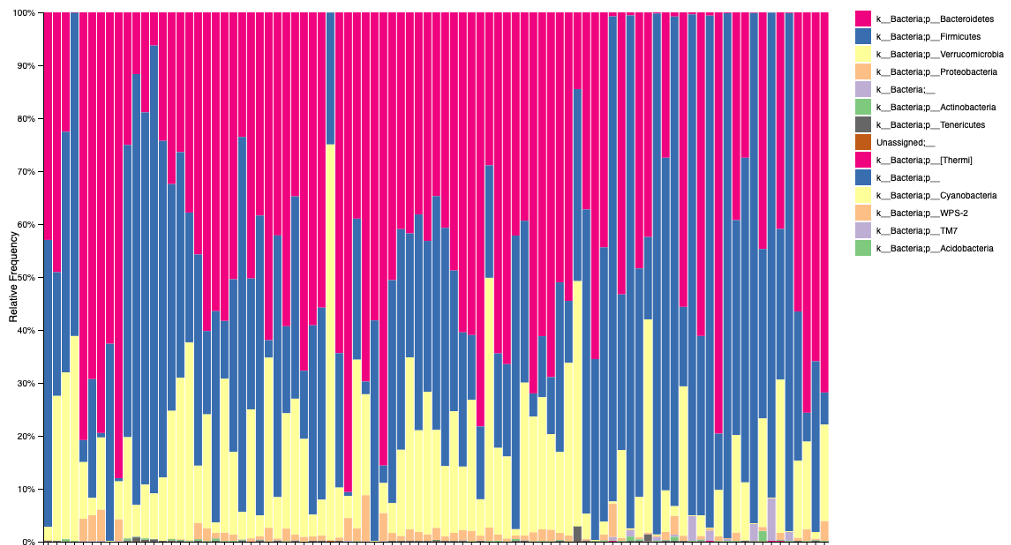
16S rRNA Amplicon Sequencing
Please complete the forms for the requested service, and bring them along with your samples.
Quantitative (q)-PCR
Standard qPCRThe method is based on the conserved 16S rRNA gene present in all bacteria (a comprehensive list of 16S rRNA sequences from gut bacteria have been deposited and categorized in the Ribosomal Database Project II ). By calculating the number of conserved 16S rRNA genes, qPCR can indirectly indicate the number of bacteria present in a given sample. Additionally, appropriate design of qPCR oligonucleotide probes (primers) that can identify the sequence of the 16S gene variable regions allows for the amplification of genes from a specific bacterium of interest whilst excluding all other bacteria, making qPCR a useful tool for quantifying specific bacteria in a complex microbial community.
The BioMark™ Systems paired with the Fluidigm Dynamic Arrays are an efficient solution for large-scale, real-time qPCR. The nanofluidic chips contain fluidic networks that automatically combine sets of samples with sets of assays. This innovative solution for real-time qPCR provides reaction densities far beyond what is possible with microtiter plates and significantly reduces the number of liquid-handling steps and the volume per reaction.
Please complete the forms for the requested service, and bring them along with your samples.
Consulting and Research Support
Includes:
- Experimental design and end-to-end microbiome project planning
- Sample collection, preparation, and nucleic acid isolation
- Library preparation and sequencing strategy selection
- Quality control and workflow troubleshooting
- Bioinformatics planning and data interpretation
- Collaborative research, pilot studies, and grant support
AMC Culture Collection
The AMC Culture Collection adds to our current services of microbiome analysis to provide well-characterized, active and viable strains for microbiome studies that demand specific bacterial groups and/or functionality. Contact us at microbiome@med.unc.edu for more information or a consultation.
Services- Strain/consortium request: This service provides well-characterized human isolates and reference probiotic bacteria for research. Lyophilized, physiologically active or glycerol stocks can be provided as requested.
- Strain submission for storage and preservation: Researchers can submit relevant strains for long term storage and preservation. Service can include strain characterization (antibiotic resistance, carbohydrate utilization and genome sequencing).
- Activation and culturing of strains: The service includes the activation of bacterial cultures under physiologically appropriate conditions. The Core will provide cultures in liquid or solid media as requested.