Our Research
Mechanisms of Cell Desensitization: Regulators of G protein Signaling
Research in the Dohlman Lab is focused on G proteins and G protein-coupled receptors (GPCRs). These receptors are the target for two-thirds of hormones and neurotransmitters, many pharmaceuticals, and most environmental signals. Generally speaking, persistent stimulation of G proteins leads to desensitization. Familiar examples include desensitization to light, odors and drugs of abuse, including opioids.
The research strategy relies on large-scale genomic, proteomic, and metabolomic analysis to identify G protein variants with altered signaling and desensitization properties. Mutants are then characterized biochemically and in cells. This effort led to the identification of the first RGS protein, which inactivates G proteins by accelerating their intrinsic GTPase activity. The lab was also the first to use mass spectrometry to map a site of protein ubiquitination in vivo, and the first to demonstrate signaling by G proteins at internal cellular compartments.
Mutations in G proteins are responsible for disease; the best-known examples are uveal melanoma and developmental epileptic encephalopathies. The lab is currently investigating how these disease mutations impose an ensemble of conformational states on the G protein α subunit, and how these states differ among the four major subclasses of Gα subtypes. Following a systematic analysis of mutations in Gαo, all linked to epileptic encephalopathies, the lab identified several that block or lock key steps of the G protein activation cycle. Most of the mutations act at a distance, by imposing or disrupting important allosteric communication networks. These studies are revealing new ways by which G proteins are activated and desensitized. In the longer term it is likely that specific conformational states can be imposed by using existing approved drugs that target GPCRs.
SELECTED PUBLICATIONS
- Knight, K. M., Krumm, B. E., Kapolka, N. J., Ludlam, W. G., Cui, M., Mani, S., Prytkova, I., Obarow, E. G., Lefevre, T. J., Wei, W., Ma, N., Huang, X-P., Fay, J. F., Vaidehi, N., Smrcka, A. V., Slesinger, P. A., Logothetis, D. E., Martemyanov, K. A., Roth, B. L., and Dohlman, H. G., A neurodevelopmental disorder mutation locks G proteins in the transitory pre-activated state. Nature Communications, 15, 6643. doi.org/10.1038/s41467-024-50964-z2024, 2024.
- Knight, K. M., Obarow, E. G., Wei, W., Mani, S., Esteller, M. I., Cui, M., Ma, N., Martin, S. A., Brinson, E., Hewitt, N., Soden, G. M., Logothetis, D. E., Vaidehi, N., Dohlman, H. G., Molecular annotation of G protein variants in a neurological disorder. Cell Reports, 42:113462, 2023.
- Hewitt, N., Ma, N., Arang, N., Martin, S. A., Prakash, A., DiBerto, J. F., Knight, K. M., Ghosh, S., Olsen, R. H. J., Roth, B. L., Gutkind, J. S., Vaidehi, N., Campbell, S. L., and Dohlman, H. G., Catalytic-site mutations confer multiple states of G protein activation. Science Signaling, 16:771:eabq7842, 2023.
- Knight, K. M., Ghosh, S., Campbell, S. L., Lefevre, T., Olsen, R. H. J., Smrcka, A. V., Valentin, H. V., Yin, G., Vaidehi, N., and Dohlman, H. G., A universal allosteric mechanism for G protein activation. Molecular Cell, 81:1-13, 2021.
- English, J. G., Shellhammer, J. P., Malahe, M., McCarter, P. C., Elston, T. C. and Dohlman, H. G., MAPK feedback encodes a switch and timer for tunable stress adaptation in yeast. Science Signaling 8:359:ra5, 2015.
- Dixit, G., Kelley, J. B., Houser, J. R., Elston, T. C. and Dohlman, H. G., Cellular noise suppression by the regulator of G protein signaling Sst2. Molecular Cell 55:85-96, 2014.
- Isom, D. G., Sridharan, V., Baker, R., Clement, S. T., Smalley, D. M. and Dohlman, H. G., Protons as second messenger regulators of G protein signaling. Molecular Cell 51:531-538, 2013.
- Clement, S. T., Dixit, G. and Dohlman, H. G., Regulation of yeast G protein signaling by the kinases that activate the AMPK homolog Snf1. Science Signaling 6:ra78, 2013.
- Cappell, S. D., Baker, R., Skowyra, D. and Dohlman, H. G., Systematic analysis of essential genes reveals important regulators of G protein signaling. Molecular Cell 38:746-57, 2010.
- Hao, N., Nayak, S., Behar, M., Shanks, R. H., Nagiec, M. J., Errede, B., Hasty, J., Elston, T. C. and Dohlman, H. G., Regulation of cell signaling dynamics by the protein kinase-scaffold Ste5. Molecular Cell 30:649-56, 2008.
- Slessareva, J. E., Routt S. M., Temple, B., Bankaitis, V. A. and Dohlman, H. G., Activation of the phosphatidylinositol 3-kinase Vps34 by a G protein a subunit at the endosome. Cell 126:191-203, 2006.
- Ballon, D. R., Flanary, P. L., Gladue, D. P., Konopka, J. B., Dohlman, H. G. and Thorner, J., DEP-domain-mediated regulation of GPCR signaling responses. Cell 126:1079-93, 2006
- Guo, M., Aston, C., Burchett, S. A., Dyke, C., Fields, S., Rajarao, S. J. R., Uetz, P, Wang, Y., Young, K. and Dohlman, H. G., The yeast G protein a subunit Gpa1 transmits a signal through an RNA-binding effector protein Scp160. Molecular Cell 12:517-24, 2003
- Dixon, R. A. F., Kobilka, B. K., Strader, D. J., Benovic, J. L., Dohlman, H. G., Frielle, T., Bolanowski, M. A., Bennett, C. D., Rands, E., Diehl, R. E., Mumford, R. A., Slater, E. E., Sigal, I. S., Caron, M. G., Lefkowitz, R. J. and Strader, C. D., Cloning of the gene and cDNA for mammalian beta-adrenergic receptor and homology with rhodopsin. Nature 321:75-9, 1986.
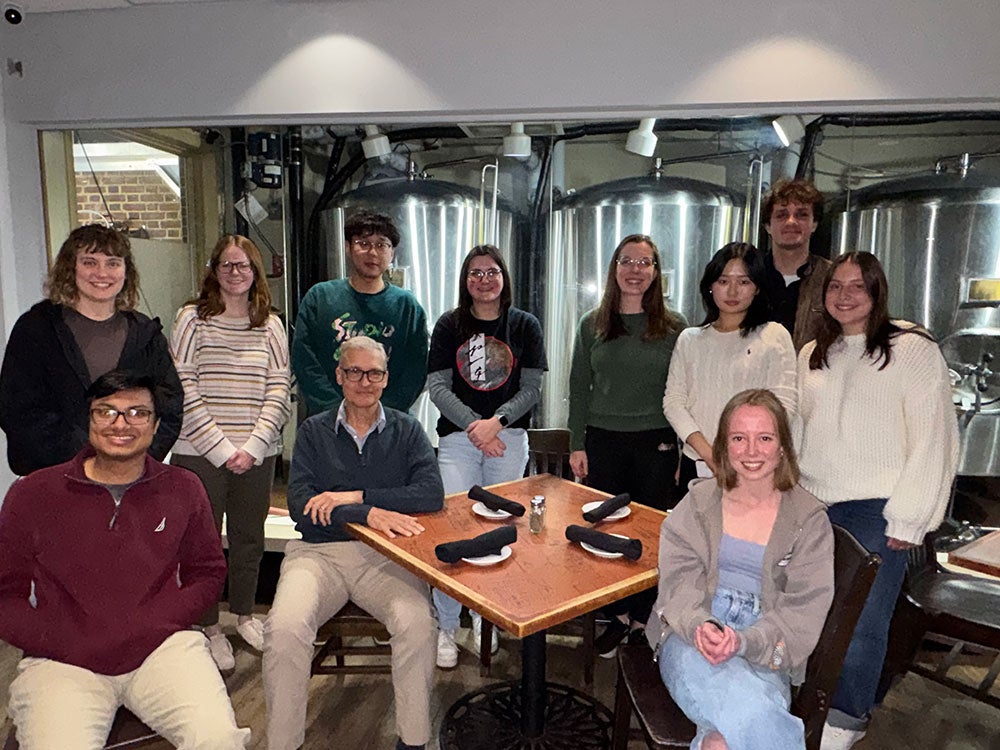
Lab 2026