FXIIIa cross-linking during fibrin formation
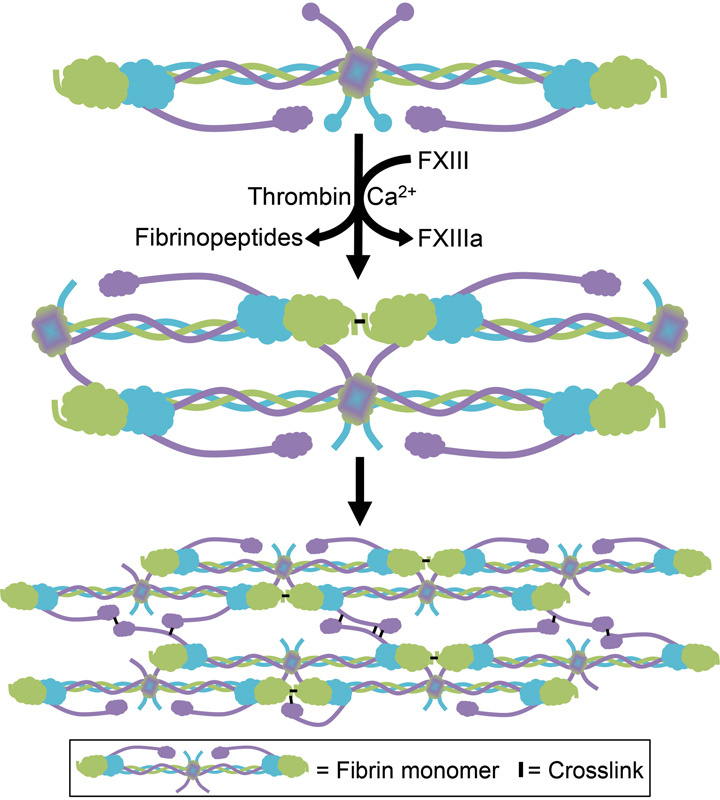
FXIIIa cross-linking during fibrin formation. Fibrinogen is a hexamer composed of 2 Aα- (purple), 2 Bβ- (blue), and 2 γ-chains (green). During coagulation, thrombin cleaves N-terminal fibrinopeptides from the Aα- and Bβ-chains, producing fibrin monomers which polymerize into protofibrils and subsequently, fibers. FXIIIa increases clot stability by introducing ε-N-(γ-glutamyl)-lysyl cross-links between residues in the γ- and α-chains of fibrin monomers within individual fibers. FXIIIa first introduces cross-links between γ-chains (forming γ-γ dimers) and subsequently between γ- and α-chains (forming high-molecular-weight species [γ-multimers, α-polymers, and αγ-hybrids]).