Loading
Sections

Skip to content. | Skip to navigation

Contact Information
UNC Division of Cardiothoracic Surgery
3040 Burnett-Womack Bldg.
CB #7065
Chapel Hill, NC
27599-7065

Phone: 919-966-3381
Fax: 919-966-3475

 
You are here: Home > Research

Research

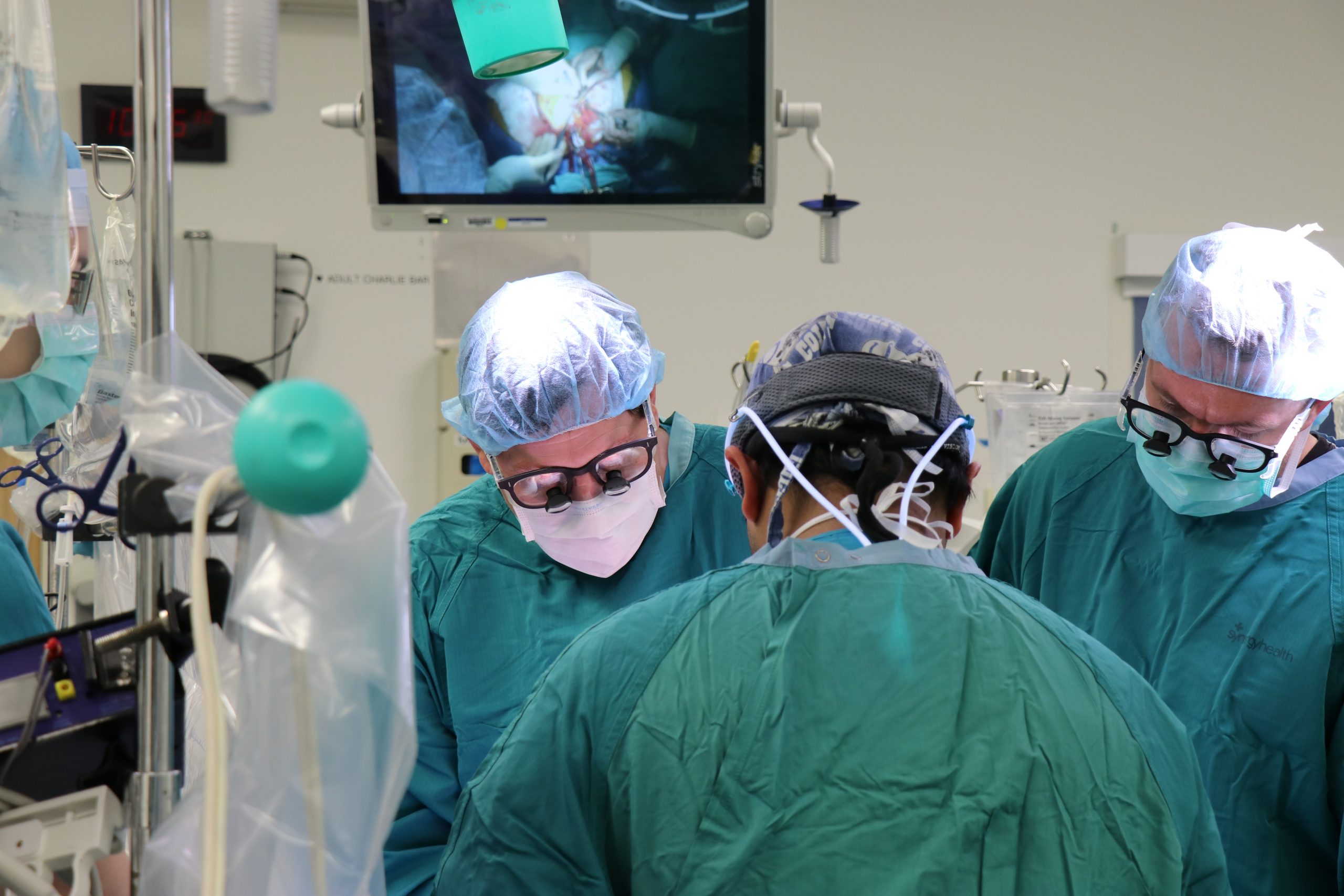
Egan lab 2As physician-scientists, we encounter questions about our patients' health and conditions, study the questions in the laboratory and then try to apply our findings back to the care of our patients. Research in the Division of Cardiothoracic Surgery at UNC includes these areas:

1) Lung transplantation: UNC is known both nationally and internationally for its lung transplantation program, particularly because of its treatment of patients with Cystic Fibrosis. Since he came to UNC in 1989 to run its lung transplant program, Dr. Thomas Egan (at center in photo, working with John Abano, M.D., left, and Boming Dong, M.D., Ph.D., right) has conducted research to study the hypothesis that lungs might be suitable for transplant even if retrieved at intervals after death and circulatory arrest. Dr. Egan's research has shown that because the lung does not rely on perfusion for cellular respiration, retrieval and transplantation of cadaveric lungs are feasible. This could greatly expand the lung donor pool, offering many more people with end-stage lung disease the opportunity to have new lungs.


Working with Dr. Egan, Dr. Benjamin Haithcock is principal investigator on a UNC IRB-approved study, "Ex-vivo evaluation of human lungs for transplant."

2)  Acute coronary syndrome outcomes for Medicare patients:  Dr. Brett Sheridan is co-principal investigator on a major study funded by NIH (National Institutes for Aging) that is examining the influence of specific therapeutic strategies in elderly people who suffer from acute coronary syndrome (ACS). The multidisciplinary research team is analyzing national Medicare data to discern the influence of demographics, physiology and specific (competing) treatments on outcomes of the elderly presenting with heart disease.

   In October and November 2008, Dr. Sheridan and his colleagues published two articles in the journal Clinical Geriatrics that reviewed use of invasive treatments in elderly people with ACS.  Read more.

hands3) Congenital Heart Disease: Pediatric congenital heart disease patients are a high‐risk group of patients who receive care in a complex system of hospital units with a number of multidisciplinary care teams. The goal of Project TICKER, Teamwork to Improve Cardiac Kids' End Results, is to improve the care of these patients by implementing a family‐centered safe practice infrastructure incorporating teamwork training and integrated clinical pathways (ICPs). Pediatric heart surgeon  Michael R. Mill, M.D., and other staff members who care for pediatric heart patients are involved in the project, which will provide tailored teamwork training and will design and implement patient care plans, known as integrated clinical pathways, to decrease unnecessary variations in care. Multiple teams, including service units (pediatric intensive care, children's intermediate cardiac care, newborn critical care, and the operating room), ancillary support (nutrition, pharmacy, patient- and family-centered care specialists, chaplain), medical teams (cardiothoracic surgery, pediatric cardiac anesthesia, cardiology, pediatric critical care, neonatology), patients, and families are partners on this project, which is supported by the Agency for Healthcare Research and Quality. Read more.

Earlier research: An earlier research effort involved examination of pulmonary blood flow physiology in congenital heart disease. This project, on which Dr. Michael Mill and Dr. Brett Sheridan were co-investigators, utilized a large animal model of the Fontan procedure. A clinical arm of the study involved Cardiac Magnetic Resonance Imaging of patients who had undergone the Fontan procedure, in an effort to correlate the laboratory findings with clinical practice and further define optimal construction of the Fontan circulation. The research, funded by NIH, was  performed in conjunction with the Department of Biomedical Engineering at UNC and includes researchers at Georgia Tech, Emory and the Children’s Hospital of Philadelphia.


   We also have been involved in a number of clinical trials, including:

    Prevent IV: Project of ex-vivo vein graft engineering via transfection of E2F decoy. This project examined the role of cell-cycle inhibition on saphenous vein graft patency used for coronary artery bypass surgery.

    STICH: The surgical treatment for ischemic heart disease study is an NIH-sponsored trial that randomizes patients with coronary artery disease and poor left ventricular function to receive either best medical therapy, coronary artery bypass surgery, or coronary artery bypass surgery with ventricular reconstruction. The latter group, at the time of surgery, has excision of scar tissue from previous heart attack in order to make the heart work more efficiently. UNC has been one of the leaders in recruitment and involvement with this trial.

    Primo-CABG II: A Multicenter, Randomized, Double-Blind trial of Pexelizumab in Patients undergoing Coronary Artery Bypass Grafting with Cardiopulmonary Bypass. This project studied the use of complement inhibition (associated with the inflammatory response) on outcomes following coronary artery bypass surgery.

    Reliant: Randomized evaluation of the Novacor Left Ventricular Assist System (LVAS) in a non-transplant population. This trial compared the use of two different ventricular assist devices as destination therapy for patients not eligible for heart transplant.

   Jarvik 2000 Multicenter Pivotal Study: This study examined the efficacy of a new generation axial flow pump for patients with decompensated heart failure as a bridge to heart transplantation.

   Freedom Trial: Randomized, prospective trial of operative versus percutaneous multivessel revascularization in diabetic patients.