By Ellie Sabel and Anna Beck
Welcome to our third blog post! With summer vacation coming up and students getting ready to spend several months away from school, this post will discuss the importance of developing strong at-home literacy environments. We introduce support for at-home literacy practices and review several ways to increase literacy engagement and enthusiasm. Finally, we provide a list of books categorized by grade level designed to boost literacy interest and promote self-regulation.
Literacy involves multiple components, including reading, writing, and speaking. Early childhood research has shown that it is essential to cultivate each of these components from a young age, as children who grow up in strong at-home literacy environments are less likely to develop writing or reading difficulties later in childhood (Esmaeeli et al. 2019). There are four essential building blocks of literacy:
- Oral Language
- Vocabulary
- Phonological Awareness
- Print Knowledge
Children generally develop these basic skills in early childhood and expand upon them throughout their education, allowing them to draw inferences from complex texts, generate comprehensive essays, and more (Regional Educational Library Program, 2020). Studies have found that in addition to improving reading and writing skills, practicing literacy at home can increase children’s reading and writing attitudesas well (Altun et al., 2022; Morrow & Young, 1997). The importance of children enjoying reading and writing should not be understated, as research shows that more positive attitudes are correlated with increased performance in both fields (Martínez et al., 2008; Graham et al., 2007).
Another skill that has been shown to increase literacy in home and school environments is self-regulation. Within an academic context,
Self-regulation refers to the socio-emotional, physiological, and cognitive skills that assist children in controlling their behaviors, overcoming challenges, and developing the necessary tools for increased independence (Skibbe et al., 2019).
Research in childhood education has found that there is a reciprocal relationship between advanced literacy and self-regulation – not only do strong literacy abilities help children develop their self-regulation skills, but strong self-regulation skills can increase children’s literacy abilities and enjoyment (McClelland et al., 2018; Skibbe et al., 2012).
Luckily, many resources exist to help parents and teachers promote strong at-home literacy and self-regulatory environments for their children and students. Much of the literacy process, especially in early childhood, involves talking with children, introducing them to new words and phrases, and sharing books and stories with them (Kosanovich et al., 2020). Below, we list several evidence-driven activities that can help advance your child’s literacy level.
- Conversations: Speaking skills, especially in early childhood, are developed through practice. It’s important to engage in conversations with your child and ask them open-ended questions that require more thoughtful answers than a simple yes or no.
- Literacy Games: Literacy-related games, like Simon Says, Apples to Apples, or even the New York Times’ Wordle, can help develop a child’s word and phonemic knowledge, as well as their enjoyment for word-related games.
- Active Reading: When you and your child are reading a story together, be sure to ask them questions and engage in discussions about the story as you read. This helps children develop their speaking and literary comprehension skills in a comfortable setting.
These activities also have the potential to help children develop their self-regulatory skills by engaging in higher-level thinking, practicing patience, and, in the case of books that explicitly exemplify self-regulatory tactics, learning from example. Below, we list several articles and books categorized by age range that were written to help children practice their literacy and self-regulation skills at home.
To learn more about developing literacy skills in early childhood, see the links below:
To learn more about developing literacy skills in middle childhood, see the links below:
To support your children’s literacy and self-regulation skills at home, we’ve included a variety of books based on grade level below! Check out our website for other blogs on self-regulation and more at-home learning support.
Books
Pre-K to Kindergarten
- Self-Regulation: The Most Magnificent Thing by Ashley Spires
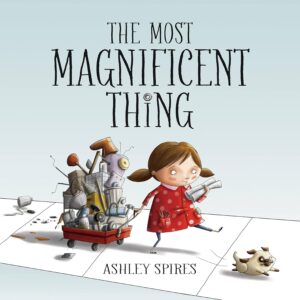
“Award-winning author and illustrator Ashley Spires has created a charming picture book about an unnamed girl and her very best friend, who happens to be a dog. The girl has a wonderful idea. ”She is going to make the most MAGNIFICENT thing! She knows just how it will look. She knows just how it will work. All she has to do is make it, and she makes things all the time. Easy-peasy!“ But making her magnificent thing is anything but easy, and the girl tries and fails, repeatedly. Eventually, the girl gets really, really mad. She is so mad, in fact, that she quits. But after her dog convinces her to take a walk, she comes back to her project with renewed enthusiasm and manages to get it just right.”
- At-Home Literacy: Rocket Writes a Story by Tad Hills
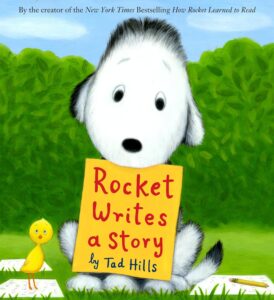
“Rocket loves books and he wants to make his own, but he can’t think of a story. Encouraged by the little yellow bird to look closely at the world around him for inspiration, Rocket sets out on a journey. Along the way he discovers small detailsthat he has never noticed before, a timid baby owl who becomes his friend, and an idea for a story.”
1st to 2nd Grade
- Self-Regulation: When Sophie Thinks She Can’t by Molly Bang

“When Sophie can’t solve a math puzzle, she feels upset and inadequate. “I CAN’T DO IT!” she shouts, expressing the frustration all of us feel when we try and fail. Will she ever be “smart” like her sister? Maybe she isn’t smart at all. LuckilySophie’s teacher steps in. What does it mean to be smart? Using current, popular “mindset” techniques, Sophie’s class is taught that we get smarter when we exercise our brains, such as when we work harder at solving a puzzle. Struggling to solve a problem doesn’t mean “I can’t do it!” Sophie and her classmates just can’t do it… yet! Readers will cheer when Sophie finally prevails, and at the end of the day, she’s confident and optimistic. At home, Sophie uses her new technique to help her dad solve a carpentry puzzle. In this third book about Sophie, Molly Bang again helps children deal with a challenging everyday issue, providing an opening to ask: What do you do when you think, “I can’t!”?”
- At-Home Literacy: Little Red Writing by Joan Holub

“Acclaimed writer Joan Holub and Caldecott Honoree Melissa Sweet team up in this hilarious and exuberant retelling of Little Red Riding Hood, in which a brave, little red pencil finds her way through the many perils of writing a story, faces a ravenous pencil sharpener (the Wolf 3000)… and saves the day.”
3rd to 4th Grade
- Self-Regulation: The Year We Learned to Fly by Jacqueline Woodson

“On a dreary, stuck-inside kind of day, a brother and sister heed their grandmother’s advice: “Use those beautiful and brilliant minds of yours. Lift your arms, close your eyes, take a deep breath, and believe in a thing. Somebody somewhere at some point was just as bored you are now.” And before they know it, their imaginations lift them up and out of their boredom. Then, on a day full of quarrels, it’s time for a trip outside their minds again, and they are able to leave their anger behind. This precious skill, their grandmother tells them, harkens back to the days long before they were born, when their ancestors showed the world the strength and resilience of their beautiful and brilliant minds. Jacqueline Woodson’s lyrical text and Rafael Lopez’s dazzling art celebrate the extraordinary ability to lift ourselves up and imagine a better world.”
- At-Home Literacy: Abdul’s Story by Jamilah Thompkins-Bigelow

“Abdul loves to tell stories. But writing them down is hard. His letters refuse to stay straight and face the right way. And despite all his attempts, his papers often wind up with more eraser smudges than actual words. Abdul decides his stories just aren’t meant to be written down…until a special visitor comes to class and shows Abdul that even the best writers—and superheroes—make mistakes.”
5th to 6th Grade
- Self-Regulation: Sidetracked by Diana Harmon Asher

“If middle school were a race, Joseph Friedman wouldn’t even be in last place–he’d be on the sidelines. With an overactive mind and phobias of everything from hard-boiled eggs to gargoyles, he struggles to understand his classes, let alone his fellow classmates. So he spends most of his time avoiding school bully Charlie Kastner and hiding out in the Resource Room, a safe place for misfit kids like him.
But then, on the first day of seventh grade, two important things happen. First, his Resource Room teacher encourages (i.e., practically forces) him to join the school track team, and second, he meets Heather, a crazy-fast runner who isn’tgoing to be pushed around by Charlie Kastner or anybody else.
With a new friend and a new team, Joseph finds himself off the sidelines and in the race (quite literally) for the first time. Is he a good runner? Well, no, he’s terrible. But the funny thing about running is, once you’re in the race, anything can happen.”
- At-Home Literacy: The Phantom Tollbooth by Norton Juster

“For Milo, everything’s a bore. When a tollbooth mysteriously appears in his room, he drives through only because he’s got nothing better to do. But on the other side, things seem different. Milo visits the Island of Conclusions (you get there by jumping), learns about time from a ticking watchdog named Tock, and even embarks on a quest to rescue Rhyme and Reason. Somewhere along the way, Milo realizes something astonishing. Life is far from dull. In fact, it’s exciting beyond his wildest dreams!”
— The UNC Writing Skills Development Program
References
Altun, D., Tantekin Erden, F. & Hartman, D.K. Preliterate Young Children’s Reading Attitudes: Connections to the Home Literacy Environment and Maternal Factors. Early Childhood Educ J 50, 567–578 (2022). https://doi.org/10.1007/s10643-021-01177-2.
Esmaeeli, Z., Kyle, F.E. & Lundetræ, K. Contribution of family risk, emergent literacy and environmental protective factors in children’s reading difficulties at the end of second-grade. Read Writ 32, 2375–2399 (2019). https://doi.org/10.1007/s11145-019-09948-5.
Graham, S., Berninger, V., & Fan, W. (2007). The structural relationship between writing attitude and writing achievement in first and third grade students. Contemporary Educational Psychology, 32(3), 516–536. https://doi-org.libproxy.lib.unc.edu/10.1016/j.cedpsych.2007.01.002.
Kosanovich, M., Phillips, B., & Willis, K. (2020). Professional Learning Community: Emergent Literacy: Participant Guide Module 4 Oral Language (REL 2020-021). Institute of Education Sciences. https://ies.ed.gov/ncee/rel/regions/southeast/pdf/REL_2021045_module4_participant.pdf.
Martínez, R.S., Aricak, O.T. and Jewell, J. (2008), Influence of reading attitude on reading achievement: A test of the temporal-interaction model. Psychol. Schs., 45: 1010-1023. https://doi-org.libproxy.lib.unc.edu/10.1002/pits.20348.
McClelland, M. et al. (2018). Self-Regulation. In: Halfon, N., Forrest, C., Lerner, R., Faustman, E. (eds) Handbook of Life Course Health Development. Springer, Cham. https://doi.org/10.1007/978-3-319-47143-3_12.
Morrow, L. M., & Young, J. (1997). A family literacy program connecting school and home: Effects on attitude, motivation, and literacy achievement. Journal of Educational Psychology, 89(4), 736–742. https://doi-org.libproxy.lib.unc.edu/10.1037/0022-0663.89.4.736.
Skibbe, L. E., Montroy, J. J., Bowles, R. P., & Morrison, F. J. (2019). Self-regulation and the Development of Literacy and Language Achievement from Preschool through Second Grade. Early childhood research quarterly, 46, 240–251. https://doi.org/10.1016/j.ecresq.2018.02.005.
Skibbe, L. E., Phillips, B. M., Day, S. L., Brophy-Herb, H. E., & Connor, C. M. (2012). Children’s early literacy growth in relation to classmates’ self-regulation. Journal of Educational Psychology, 104(3), 541–553. https://doi-org.libproxy.lib.unc.edu/10.1037/a0029153.