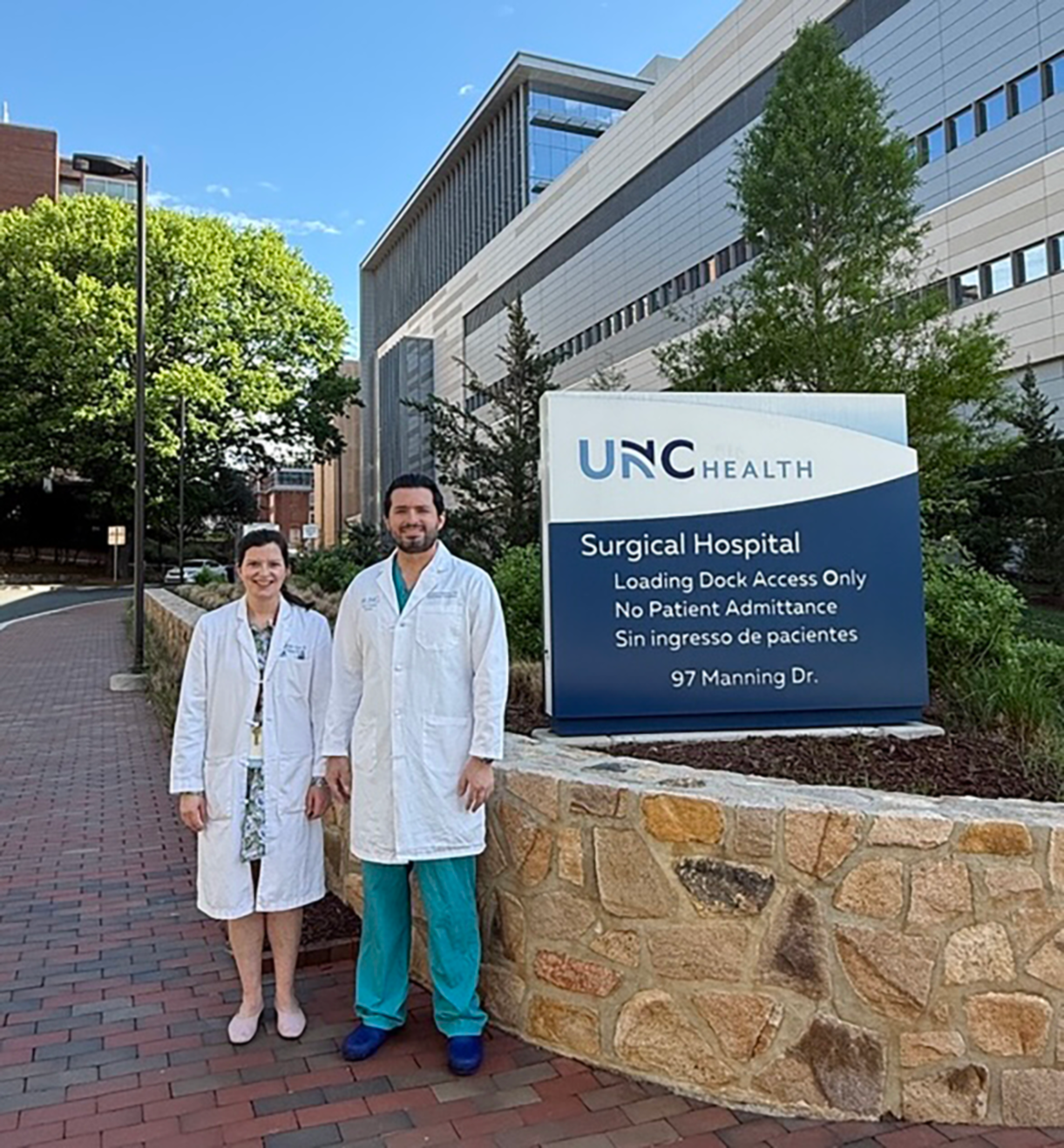
Elizabeth Arant, MD, and Esteban Calderon, MD
CHAPEL HILL, N.C. — UNC Health now offers kidney transplants from donors with HIV to recipients with HIV, dramatically shortening wait times for carefully selected patients living with HIV. This progress builds on more than a decade of experience under the federal HIV Organ Policy Equity (HOPE) Act and UNC’s integrated expertise in HIV care, transplant nephrology, surgery and infectious diseases.
“Previously, people with HIV weren’t allowed to be organ donors. The HOPE Act changed that by allowing organs from donors with HIV to go to recipients with well‑controlled HIV, first under research, and the data have been really reassuring,” said Elizabeth Arant, MD, infectious disease physician at UNC. “Outcomes for patients who receive kidneys from donors with HIV are comparable to those receiving organs from donors without HIV. This means a whole pool of organs that used to be discarded, can now be used, and this cuts months to years off the wait time for transplants.”
The HOPE Act
The HIV Organ Policy Equity Act (HOPE), enacted in 2013 and implemented in 2015, authorized transplantation of organs from donors with HIV to recipients with well‑controlled HIV under research protocols at select U.S. centers. Over the subsequent decade, multi‑site trials demonstrated that kidney outcomes for recipients of organs from donors with HIV were comparable to those for organs from donors without HIVs, with no clinically significant increase in HIV superinfection or adverse graft outcomes. Trials also showed that people with HIV who did not receive HIV‑positive donor organs waited an average of about 60 months on the transplant list, while HOPE recipients of HIV‑positive kidneys waited roughly 10 months. Recent policy changes have allowed kidney transplants from donors with HIV to move out of research and into standard clinical practice, enabling centers like UNC to integrate HOPE organs into routine transplant pathways.
The First Patient
The first UNC patient, referred in mid‑2025 with HIV‑associated kidney disease, illustrates this progress. After beginning evaluation in October 2025, the patient was approved and listed in early 2026, receiving a HOPE kidney offer just six weeks later—an outcome that, before HOPE, might have required years on dialysis and the waitlist.
“This is one of the rare situations where having HIV can actually be an advantage on the waitlist, because only a small group of patients is eligible to receive these organs,” said Arant an assistant professor of medicine. “We’re taking organs that previously would have been discarded and using them to save lives.”
UNC Health’s Kidney Transplant team—led by Alex Toledo, MD, surgical director of kidney transplant; Chirag Desai, MD, division chief of abdominal transplant; and Karin True, MD, the medical director—launched the HOPE Kidney Program with Infectious Diseases, in close collaboration with a growing robotic kidney transplant initiative. That effort is led by Esteban Calderon, MD, an abdominal transplant surgeon who joined UNC Health in 2024 to establish the robotic program, who also performed UNC’s first HIV‑positive–to–HIV‑positive kidney transplant, drawing on prior HOPE trial experience.
 |
| Karin True, MD, and Chirag Desai, MD |
“Both of our recent HIV‑positive to HIV‑positive kidney transplants have been done robotically,” Calderon said. “A traditional kidney transplant incision is quite large. With robotic surgery, the incisions are much smaller, there is less post-operative pain, therefore recovery is easier and patients are often going home just a couple of days after their transplant. Our first HOPE kidney recipient is already doing great—when I last saw him in clinic, he was making three liters of urine a day after not making any before and was off dialysis with a working graft.”
HOPE kidneys offer an additional advantage: they are often low Kidney Donor Profile Index (KDPI) organs, meaning their donor characteristics predict longer graft longevity compared with most kidneys transplanted in the prior year. Organs of this quality are typically reserved for very young or pediatric recipients; through the HOPE pathway, however, some older patients with HIV are receiving exceptionally high‑quality kidneys earlier in the course of their disease.
“The advantage of HOPE kidneys is not only that patients are transplanted much faster—often in months—they’re receiving very high‑quality kidneys that previously would have gone only to very young or pediatric recipients,” said Calderon.
UNC’s Executive Medical Director for UNC Healthcare Center for Transplant Care, Chirag S. Desai, MD, has encouraged expanding robotic HOPE kidney use to further minimize occupational risk while broadening access for patients.
“A major advantage of combining HOPE kidneys with robotics is that there’s very little direct manipulation of blood and tissue, which reduces the risk of needle sticks or blood exposure for the care team—an important consideration when donors may have high viral loads,” Calderon said.
Screening Patients
Arant and the HIV infectious diseases team work closely with nephrology and surgery to review each donor and recipient pair. They assess HIV histories, antiretroviral regimens and any concern for opportunistic infections, to ensure that each recipient’s HIV therapy will fully cover any potential new viral strain and keep the risk of HIV “superinfection” extremely low.
The program, True emphasizes, benefits both sides of the transplant equation.
“HOPE transplants don’t just benefit recipients; they create equitable access to donation.” “People with HIV can now be organ donors in a meaningful way, when previously that wasn’t allowed. It’s a powerful way for our patients to contribute to the lives of others.”
The Future
While UNC is currently focused on kidney transplants, national HOPE experience suggests that HIV‑positive organs may also have a large impact on other solid organ transplantation, where patients are often critically ill and lack a “backup” like dialysis.
“For now, we’re focused on making sure every eligible patient knows the option for a HOPE kidney exists,” True said. “The broader message is that HIV should no longer be seen as an automatic barrier to advanced care. With the right team and safeguards, patients with HIV can do just as well after transplant—and, in many cases, get to transplant much sooner. For the individual patient, that difference is enormous—less time on dialysis, better long‑term kidney function, and more years of life.”