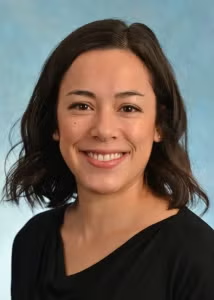
 Louise Thoma, PT, DPT, PhD, began her academic training at The Ohio State University, where she completed physical therapy school and earned her PhD, focusing on how people move using tools such as biomechanics. Specifically, she worked with individuals who suffered cartilage injuries in their knees.
Thoma continued her training at the University of Delaware, where she worked on understanding what people do outside the clinic. She examined patients’ physical activity levels and the consequences of knee injuries and osteoarthritis.
While Thoma had not initially planned to specialize in rheumatology, her perspective shifted during her first year at UNC after attending the American College of Rheumatology conference. Sitting next to a physical therapist at a networking lunch, Thoma learned that rehabilitation is needed for people with many other rheumatic diseases. This got her thinking about what those limitations are and why they are not discussed more in physical therapy education.
After that conference, Thoma began to pursue her own research in this area. She wanted to understand the limitations of this patient population and why she had not learned more about it in PT school. She spoke with retired colleagues and conducted a literature review, which showed that many physical therapists previously worked in rheumatology. However, the field became less common in the early 2000s due to advances in disease-modifying medications.
Thoma realized that while these medications were improving disease activity, physical function was not improving to the same extent. This gap highlighted an opportunity for rehabilitation to play a more prominent role in contemporary rheumatology care.
Thoma worked with colleagues at the Thurston Arthritis Research Center to develop a career development award proposal for the National Institutes of Health (NIH), which targeted how to better integrate rehabilitation into routine rheumatology care for people with rheumatoid arthritis. The grant was awarded in 2021 and gave Thoma five years to study how rehabilitation fits into rheumatology and why gaps in care exist.
Through this research, the PREVAIL model of care was created. PREVAIL stands for Preserving Valued Activities in Life. This model focuses on how rehabilitation and exercise can help preserve people’s ability to do the activities that matter most to them.
“We tested a model of care that uses a functional screening tool during a routine visit,” Thoma said. “We use that information to guide the rheumatologist and help them understand when a patient might benefit from rehabilitation, so people are learning about it earlier.”
The grant is now in its final year, with all planned projects completed and final data collection finished in November. Two major findings emerged from the research. First, patients do not learn much about rehabilitation during their care, but they want to — especially as an early option beyond medication to maintain function and overall health. Many people with rheumatoid arthritis and other rheumatic conditions are afraid to exercise due to past symptom flares or fear of making their condition worse. Second, rheumatologists are often hesitant to introduce rehabilitation because patients are managing a complex condition, and providers do not want to overwhelm them during a standard 20-minute visit.
To address this gap, Thoma adapted a consultative physical therapy model originally developed in neurology, particularly for people with Parkinson’s disease, where early and consistent exercise has also been shown to preserve function and quality of life. This led to the launch of the Consultative Physical Therapy for Rheumatology Program within UNC’s faculty practice. Unlike traditional physical therapy, which is often short-term and intensive, this model focuses on long-term behavior change and confidence in exercise. Patients receive a comprehensive evaluation followed by one to three follow-up visits over two to four months, with the goal of helping individuals exercise confidently to maintain their function long-term and return to care as their needs change.
Moving forward, Thoma is developing additional grants to expand this work. Her next steps are to refine the model for implementation within UNC Health and eventually scale to other medical systems. Her long-term goal is to maximize participation and quality of life for adults with rheumatoid arthritis and other rheumatic diseases.