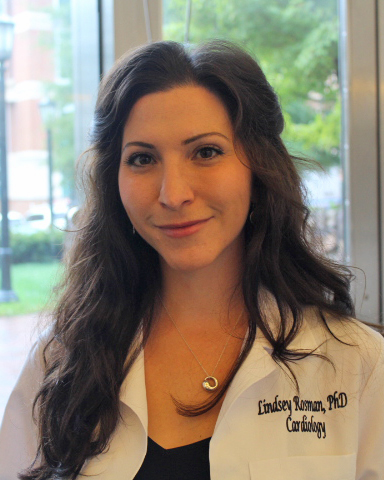
Lindsey A. Rosman, PhD
Assistant Professor of Medicine
Co-Director, Cardiovascular Device and Data Science Lab
Director, Cardiovascular Behavioral Medicine Service
Areas of Interest
Advanced data science approaches and machine learning; Cardiac electrophysiology and cardiovascular implantable electronic devices (CIEDs); Precision medicine; Acceptance, adoption and implementation of new health technologies (e.g., wearable devices and implanted biosensors, remote patient monitoring, and mHealth); Psychosocial and environmental risk factors for cardiovascular disease (CVD).
About
Dr. Rosman is a Data Scientist and Licensed Clinical Health Psychologist. As Co-Director of the UNC Cardiovascular Device and Data Science Lab, her highly interdisciplinary research focuses on the intersection of cardiovascular medicine, electrophysiology, data science, behavioral medicine, bioengineering, and biostatistics.
Dr. Rosman’s research program centers on using advanced data science methodologies to transform how we prevent, detect, and treat cardiac arrhythmias and other heart conditions by making complex health data more accessible, interpretable, and actionable for patients and their healthcare teams. Her work leverages machine learning and artificial intelligence to create innovative informatics tools that aggregate and simultaneously analyze complex health data from diverse sources, including wearable devices, implanted biosensors, cardiac devices, and electronic health records, to create AI-powered tools that can predict which patients are at highest risk for heart problems and suggest personalized prevention strategies. As a practicing psychologist in cardiology, she also understands that even the most advanced technology is only effective if patients and healthcare providers will actually use it. Thus, her work incorporates evidence-based strategies to ensure that new digital health tools are designed in ways that patients find helpful and that doctors can easily integrate into their daily practice.
Dr. Rosman’s research is supported by funding from the National Institutes of Health and industry collaborators. Her recently completed NHLBI K23 Career Development Award focused on developing computationally efficient algorithms for processing physiological sensor data from implanted cardiac devices, establishing foundational methodologies for large-scale cardiovascular data analysis. Additionally, as the PI of the UNC Cardiovascular Device Surveillance Registry, Dr. Rosman oversees one of the nation’s largest prospective clinical research registries, encompassing over 18,000 patients with implanted cardiac monitors, pacemakers, and ICDs across diverse demographics (44% women; ages 5-103 years). This comprehensive dataset supports multiple research studies, including the development of AI enabled tools, mechanistic studies of cardiovascular therapeutics, epidemiological investigations of psychosocial and environmental CVD risk factors, and methodological research developing novel statistical approaches for causal inference in observational studies through target trial emulation. Dr. Rosman also serves as PI and Co-I on prospective cohort studies and randomized controlled trials examining the real-world impact of consumer wearable devices on healthcare utilization patterns and psychological wellbeing among cardiovascular patients. Ongoing work includes intervention studies designed to optimize patient adherence to remote monitoring technologies.
Media/Press Interviews
Lindsey Rosman, PhD, explains how stress could be a risk factor for stroke in the death of a U.S. Capitol police officer in an interview with CNN.
Dr. Rosman appeared on CNN’s morning show ‘New Day’ and was interviewed by reporters at national and international media outlets [The Guardian (London), The Telegraph, CNN, ABC, NBC, Yahoo News, etc.] for her new study: Arrhythmia Risk During the 2016 United States Presidential Election: The Cost of Stressful Politics
Dr. Rosman’s research was featured in National Geographic Magazine, “Wearable fitness trackers are making us anxious—here’s how to stop it.”
Remote Cardiac Device Monitoring During COVID-19 (Everyday Health, 2020)
Stroke Increased for Younger Adults with PTSD (Forbes, 2019)
PTSD tied to higher, earlier stroke risk (Reuters, 2019)
Strokes are becoming more common in younger adults and PTSD may be a cause (ABC News, 2019)
New Study Finds Link Between Post Traumatic Stress Disorder and Increased Risk of Developing Atrial Fibrillation (Heart Rhythm Society, 2018)
Patents
Dr. Rosman received a provisional patent for her machine learning software, “Methods, Systems, And Computer Readable Media for Machine-Learning-Based Prediction of Adverse Outcomes Using Data from Implantable or Wearable Cardiac Devices”. [U.S. Provisional Patent Application 63/684,842, awarded 8/2024].
Clinical Practice
As Director of the Cardiovascular Behavioral Medicine Service, Dr. Rosman provides psychological assessments and evidence-based treatments to patients with heart rhythm disorders and heart failure. She works closely with cardiology teams to address the psychological challenges of cardiac diagnoses and treatments, supporting both patients and families through this process. This work also provides essential insights that directly inform her research.
-
Undergraduate
Purdue University
-
PhD
East Carolina University
-
Behavioral Medicine/Psychology Residency
Brown University
-
Cardiovascular Outcomes/Medical Informatice Research Fellowship
Yale School of Medicine