On Monday September 6, at sunset, Jewish communities in North Carolina and around the world will celebrate Rosh Hashanah, the Jewish New Year. On Wednesday, September 15, Hispanic Heritage Month begins.
 Rosh Hashanah, the Jewish New Year, is one of Judaism’s holiest days. Rosh Hashanah commemorates the creation of the world and marks the beginning of the Days of Awe, a 10-day period of introspection and repentance that culminates in the Yom Kippur holiday, also known as the Day of Atonement. Rosh Hashanah and Yom Kippur are the two “High Holy Days” in the Jewish religion.
Unlike modern New Year’s celebrations, Rosh Hashanah is a contemplative holiday. Work is prohibited, and religious Jews spend much of the holiday attending synagogue. Because the High Holy Day prayer services include distinct liturgical texts, songs and customs, rabbis and their congregations read from a special prayer book known as the machzor during both Rosh Hashanah and Yom Kippur. The sounding of the shofar—a trumpet made from a ram’s horn—is an essential and emblematic part of both Rosh Hashanah and Yom Kippur. After religious services are over, many Jews return home for a festive meal steeped in symbolism and tradition. The meal typically begins with the ceremonial lighting of two candles and features foods that represent positive wishes for the new year.
Customs and Symbols of Rosh Hashanah
Apples and honey: One of the most popular Rosh Hashanah customs involves eating apple slices dipped in honey, sometimes after saying a special prayer. Ancient Jews believed apples had healing properties, and the honey signifies the hope that the new year will be sweet.
Round challah: On Shabbat (the Jewish Sabbath) and other holidays, Jews eat loaves of the traditional braided bread known as challah. On Rosh Hashanah, the challah is often baked in a round shape to symbolize either the cyclical nature of life or the crown of God.
“L’shana tovah”: Jews greet each other on Rosh Hashanah with the Hebrew phrase “L’shana tovah,” which translates to “for a good year.”
Learn more at history.com.
Hispanic Heritage Month
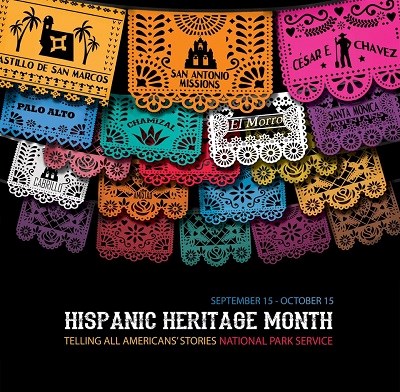
National Hispanic Heritage Month traditionally honors the cultures and contributions of both Hispanic and Latino Americans as we celebrate heritage rooted in all Latin American countries. During this month and throughout the year, the National Park Service and our partners, share history, heritage, and accomplishments of Hispanic and Latino Americans of past and present.
Hispanic refers to a person who is from, or a descendant of someone who is from, a Spanish-speaking country.
Latino/a or Latinx refers to a person who is from, or a descendant of someone who is from, a country in Latin America
 Why the Date of Hispanic Heritage Month Is Important
The timing of Hispanic Heritage Month coincides with the Independence Day celebrations of several Latin American nations. September 15 was chosen as the kickoff because it coincides with the Independence Day celebrations of five “Central American neighbors,” as Johnson called them—Costa Rica, El Salvador, Guatemala, Honduras and Nicaragua. Those five nations declared their independence from Spain on September 15, 1821.
In his proclamation, Johnson also acknowledged Mexico, which declared its independence from Spain on September 16, 1810. Although not mentioned specifically by Johnson, Chile also celebrates its independence during that week (September 18, 1810 from Spain) and Belize, which declared its independence from Great Britain on September 21, 1981, was subsequently added to the list of nations specifically celebrated during what is now Hispanic Heritage Month.
From 1968 until 1988, Presidents Nixon, Ford, Carter and Reagan all issued the yearly proclamations, setting aside a week to honor Hispanic Americans. In 1987 U.S. Representative Esteban E. Torres of California proposed the expanding the observance to cover its current 31-day period. Torres wanted more time so that the nation could “properly observe and coordinate events and activities to celebrate Hispanic culture and achievement.”
In 1988, Senator Paul Simon (D-Illinois), submitted a similar bill that successfully passed Congress and was signed into law by President Ronald Reagan on August 17, 1988. And on September 14, 1989, President George H.W. Bush (who had been a sponsor of the original Hispanic Heritage Week resolution while serving in the House in 1968) became the first president to declare the 31-day period from September 15 to October 15 as National Hispanic Heritage Month.
“Not all of the contributions made by Hispanic Americans to our society are so visible or so widely celebrated, however. Hispanic Americans have enriched our nation beyond measure with the quiet strength of closely knit families and proud communities,” Bush said.
In the decades since, National Hispanic Heritage Month proclamations have been made by every sitting president of the United States
Visit History.com or HispanicHeritageMonth.gov to learn more.