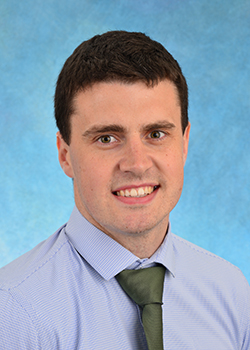
Associate Professor of Medicine Dr. David Lynch was recently awarded a K23 from the NIA. According to the NIH, the K23 award provides support for, “an intensive, mentored research career development experience for individuals with a clinical doctoral degree who have made a commitment to patient-oriented research.” It also provides five years of salary and research support for investigators who have made a commitment to focus on patient-oriented research.
As a fellowship-trained Geriatrician and physician-investigator, Dr. Lynch has developed expertise in quality improvement, observational research, and secondary analysis of clinical trials. His long-term goal is to establish an independently funded research program that develops, tests, and implements scalable interventions to improve quality of life for people living with dementia and their caregivers.
The specific goal of Dr. Lynch’s research proposal is to develop and pilot test ACTIVE-AD—Activity and Exercise for hospitalized people with Alzheimer’s Disease and Related Dementias. This intervention would seek to address the gap in effective, scalable, and sustainable strategies to tailor hospital care for people living with dementia.
Dr. Lynch’s commitment to Geriatric Medicine began in medical school at the University of Limerick in Ireland. As he says, “During a general practitioner rotation, I was inspired by a physician with a relentless commitment to a predominantly older rural community.” While doing his Internal Medicine residency at UNC, Dr. Lynch witnessed geriatricians’ similar dedication to caring for older adults. This inspired his focus on a Geriatric Medicine clinical fellowship. In 2021, Dr. Lynch started his faculty role in the UNC Division of Geriatric Medicine. In this role, he has seen the power of research to address persistent challenges in clinical geriatrics.
Dr. Lynch’s current research is a direct extension of his clinical observations. As he says, “Throughout residency and fellowship, I was struck by the consistency with which patients described maintenance of function as their top healthcare priority.” As Dr. Lynch cared for numerous patients during and post-hospitalization, both in clinic and in the nursing home, he witnessed the impact of hospital-associated disability. Additionally, he noted the physical decline was often most pronounced in vulnerable older adults and especially in those living with dementia.
Despite the impact on overall quality of life, it was clear to Dr. Lynch that current medical training and healthcare delivery wasn’t prioritizing evidence-based interventions to reduce physical decline and hospital associated harm. Consequently, the K23 award is a large step towards him becoming a clinical trialist who helps people living with dementia maintain physical function.