The Clinical Laboratory Science Program at UNC-CH
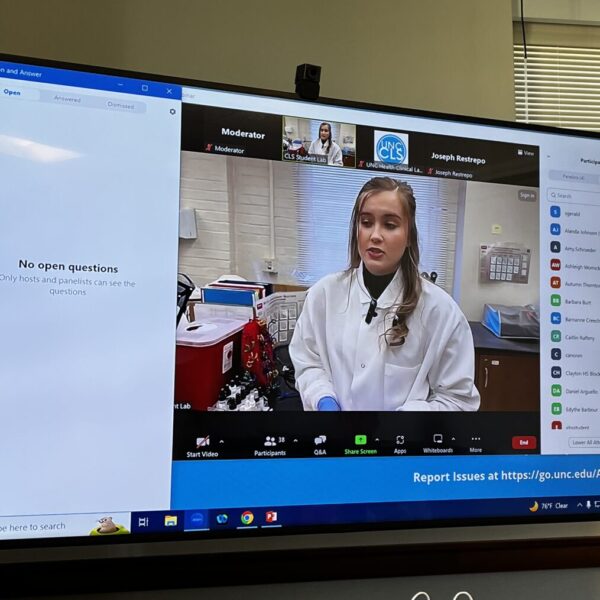
The Clinical Laboratory Science program at The University of North Carolina at Chapel Hill is a two-year program covering the major areas of clinical laboratory science: hematology, hemostasis, microbiology, chemistry, immunohematology and immunology. In the first year of the program, students take lecture and laboratory courses emphasizing the principles and procedures involved in laboratory tests. The second year involves advanced coursework and clinical laboratory rotations at the University of North Carolina Hospitals and other laboratory settings across the state of North Carolina.
The UNC-CH CLS Program is accredited by the National Accrediting Agency for Clinical Laboratory Science (NAACLS),
8410 W Bryn Mawr Ave, Suite 670, Chicago, IL 60631-3415
Mission Statement
The primary mission of the Division of Clinical Laboratory Science is to prepare competent clinical laboratory scientists with the knowledge, skills and attitudes that are required to fulfill current and future professional roles and leadership positions as members of the health care team. The division is committed to contributing to the knowledge base of clinical laboratory science through research, to transmitting that knowledge to other professionals, and to strengthening the profession through service. These statements are consistent with the mission of the Department of Allied Health Sciences, the School of Medicine and the University of North Carolina at Chapel Hill.
History of the CLS Program at UNC-CH
The UNC program to prepare graduates to work in clinical laboratories is at least 50 years old. Although records of a formal training program do not exist prior to 1952 (the year Memorial Hospital opened) a single course in "clinical pathology" offered by the medical school in the 1940's may have been one way to prepare undergraduates to meet a shortage of trained laboratory staff during World War II.
Prior to 1993, the educational program was referred to as "medical technology". A description of the medical technology program is found in the medical school catalogue of 1952-3. Both a 4-year and a 5-year curriculum were offered. A student took 3 or 4 years of undergraduate courses followed by 12 months of "training" at Memorial Hospital at UNC Chapel Hill. Students were taught at the bench by staff in a variety of laboratories. At that time, women could enroll as freshmen or sophomores at UNC only if they majored in medical technology, pharmacy, or nursing. Early program directors were Miss Lois Tillman and Miss Louise Murphy Ward.
Over the years, the curriculum has changed frequently, reflecting scientific advances in laboratory medicine, the status of the program within the institution, a better understanding of student needs, and the requirements of accrediting agencies. In the 1960s, the clinical training component consisted of 18 months of hospital work. The medical technology program became part of the School of Medicine's newly formed Department of Medical Allied Health Professions (now the Department of Allied Health Sciences) in 1973-4. The current "2 + 2" format, with 4 semesters of courses integrating lectures, student laboratories, and clinical courses, was begun in the late 1970s. Clinical experiences are held at a wide variety of sites in addition to the McLendon Laboratories of UNC Hospitals. The name medical technology was changed to "clinical laboratory science" in 1993. Today's students earn a baccalaureate degree in clinical laboratory science from the Division of Clinical Laboratory Science.
Written by Rebecca Laudicina from information provided by Kay Johnson, class of '68, and contained in The Way It Was, Chapter 8, by John Graham, MD.
UNC School of Medicine