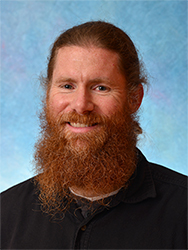
 Terry Furey, Professor of Genetics & Biology, was recently highlighted in the article “Graduate with ‘orphan diseases’ transformed by quantitative genomics” in UNC’s “The Well” publication.
Original article appears HERE.
Graduate with ‘orphan diseases’ transformed by quantitative genomics
With help from family and friends and University accommodations, Daniel Meng-Saccoccio is ready for Winter Commencement.

Daniel Meng-Saccoccio can’t predict if his medical conditions will let him leave home. That’s why his plans to finish college by attending Winter Commencement are particularly meaningful.
A Carrboro High School graduate, he wanted an academically rigorous path in college. He chose the quantitative biology track and will graduate with a bachelor’s degree in biology.
His interest in data-driven biology deepened through courses such as analysis and interpretation of sequence-based functional genomics. The class was taught by Terry Furey, a professor in the College of Arts and Sciences’ biology department and the UNC School of Medicine’s genetics department. Meng-Saccoccio recalls the class as transformative.
“He was fantastic,” he said. “This was a quantitative genomics class, and we did so much fun, cool stuff, learning to interpret basic different functional applications of genomic topics. We used coding to expand on that to make predictions, do some analysis.” Students selected an interesting topic with publicly available genetic data, used Linux to align and assess samples and built reports based on their analyses.
He planned to study medicine. “I wanted to shadow people at the hospital, to volunteer, to get ready for med school. But that fell through because I wasn’t able to sustain taking classes and all of that. My health progressively got worse,” he said.
Several of his conditions qualify as “orphan diseases,” defined as affecting fewer than 200,000 people in the U.S. Such conditions may take years to diagnose because symptoms mimic more common disorders.
Meet the winter graduates
Read more about the Tar Heels graduating from Carolina on Sunday, Dec. 14.
“Not many doctors are familiar with some of the conditions that I have,” he said. “It took quite a while before some doctors recognized what I was experiencing.”
One condition is myalgic encephalomyelitis, aka chronic fatigue syndrome, characterized by extreme, unpredictable exhaustion.
Another condition, orthostatic intolerance, affects Meng-Saccoccio’s blood flow. “If I stand or walk for too long, I’ll get nauseous or dizzy,” he said. When he uses a wheelchair, his posture is closer to a 90-degree angle, which slows the drop in blood pressure.
In his first year, Meng-Saccoccio connected with Accessibility Resources and Service (which merged with the University Compliance Office in 2024) for help in securing accommodations. As diagnoses were confirmed, the University approved accommodations such as extended testing time and remote class attendance.
He lives on campus in Ram Village. His family supplies lots of support. “Sometimes it’s hard for me to do basic things every day. I don’t have the energy to take out the garbage or cook,” he said. “That my family comes by to help me and they walk with me is probably the biggest blessing that I’ve had in my time here.”

Meng-Saccoccio sipped from the Old Well in 2023 after it reopened with a sloped pathway. (Johnny Andrews/UNC-Chapel Hill)
The 21-year-old found additional support through Tar Heels at the Table, a disability advocacy group. The organization has worked on accessibility improvements, including construction of a sloped pathway at the Old Well. “Some of my best friends who understand what I’m going through have been from that group,” he said.
Meng-Saccoccio considered majoring in English but found an outlet for his writing by minoring in medicine, literature and culture through Honors Carolina. He published “Deep Diagnosis Jungle: Besting the Beast of My Orphan Disease” in The Health Humanities Journal of UNC-Chapel Hill. Courses in bioethics, religion and medicine, and comparative healing systems helped him bridge scientific and humanistic perspectives, an intersection he hopes to study after graduation.
Reflecting on his final weeks at Carolina, he finds “the greatest part has to be the people here,” he said. “I’ve met some truly wonderful friends here at UNC and also some truly amazing professors who don’t just know a lot, they care a lot.”