


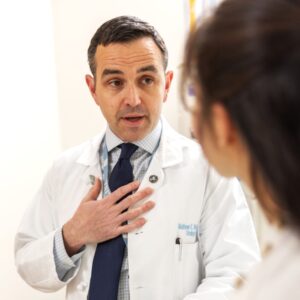
 The American Urological Association (AUA), the largest international professional organization for the discipline of urology, convenes this week in Washington, DC for the 2026 Annual Meeting. This marks a transition in leadership, with Dr. Matthew Nielsen completing his four year term as Chair of the AUA’s Science and Quality Council (SQC), providing strategic oversight to shape and execute on a broad agenda spanning the AUA’s Quality Improvement and Patient Safety (QIPS), Data, and Guidelines Committees.
The work of SQC intersects with initiatives across AUA’s mission areas. One foundational effort in this period was development of the National Quality Agenda and Strategies for Urologic Practice, authored by Nielsen in collaboration with leaders from the American Board of Urology. This document articulates priorities and strategies to guide quality activities for the next decade, detailed in an AUANews article and an AUA Inside Tract podcast episode.
Enhancing Diagnostic Excellence is a key priority area in the Quality Agenda, defining several new directions for the SQC in this period, disseminated through AUA publications and podcasts. Yang and colleagues (2021) define diagnostic excellence as “an optimal process to attain an accurate and precise explanation about a patient’s condition. An optimal process would be timely, cost-effective, convenient, and understandable to the patient. An accurate and precise diagnosis gains clinical value insofar as it leads to better choices in treatment.” As SQC Chair, Nielsen led several efforts related to Diagnostic Excellence in prostate cancer care. These include resources to support person-centered care in prostate cancer screening, supported by a grant from the Council of Medical Specialty Societies (CMSS), as well as a multidisciplinary QI summit on improving the quality of prostate MRI, supported by his fellowship in Diagnostic Excellence from the National Academy of Medicine. Alongside this work, Nielsen served on the National Quality Forum (NQF) Diagnostic Excellence Committee, contributing to the development of cross-cutting quality measures in this area.
Below, we summarize activities within each committee during the period of Dr Nielsen’s SQC leadership.
The QIPS committee stewards a broad portfolio of activities related to performance improvement. These efforts provide instrumental support for members’ QI activities, including in this period publication of a QI Project Guide as well as playbooks for topic-specific QI initiatives in the Engage with Quality Improvement and Patient Safety (E-QIPS) guides and a webinar on Using Lean Methodology to Increase Clinic Efficiency. QIPS also stewards a portfolio of urology-specific quality measures incorporated into federal quality payment programs. AUA led a multi-stakeholder collaboration to draft a Merit-based Incentive Payment System (MIPS) Value Pathway (MVP) for Urology. During this period, AUA produced a Healthcare Performance Measurement Primer, with leadership from UNC faculty and QIPS committee member David Friedlander, toolkits for MIPS and MVPs, and a webinar focused on the new Urology-specific MVP. The QIPS committee also convened multidisciplinary QI Summits in Palliative Care (2022), Telehealth in Urology (2023) and Diagnostic Excellence (2024), with toolkits, resources, and summit proceeding papers available as enduring materials on the AUA website. Most recently, AUA QIPS leaders secured funding from the Council of Medical Specialty Societies to promote adoption of the Age-Friendly Health Systems 4Ms Framework—What Matters, Medication, Mentation, and Mobility—into routine practice.
Under the leadership of UNC faculty Ray Tan, committee Chair, the Data Committee has driven the field forward with a variety of efforts. The AUA Quality Registry (AQUA), approved by CMS as a Qualified Clinical Data Registry, provides unique insights on real-world care and a vehicle for members to identify opportunities for quality improvement. AQUA includes more than 13 million unique patients, with 54 physician performance measures, including 16 measures that are urology-specific, stewarded by AUA and the QIPS committee. AUA partnered with the American Board of Urology to facilitate potential receipt of QI Attestation credit for the Continuing Urologic Certification (CUC) program for those who actively engage with the AQUA Registry. The AUA Census provides unique insights into urology practice and the urology workforce, and has provided invaluable data to support AUA’s policy and advocacy efforts. A new effort under Dr Tan’s leadership was the launch of AUA’s Data Research Program (DRP). Towards the goal of democratizing access to AUA Data, The DRP launched in May 2023 with six projects awarded annually since 2024.
AUA’s Guidelines are consistently identified by members as one of the most valued activities of the organization. Reflecting this, the Guidelines website saw over 5 million views in this period; in addition, all Guidelines content is available in a Guidelines-at-a-Glance mobile app. The latest development, announced just before the Annual Meeting, is a new partnership between AUA and OpenEvidence, a leading AI-powered clinical decision support platform, to expand the reach of AUA’s evidence-based Guidelines at the point of care. During this period, the Practice Guidelines Committee (PGC) published new Guidelines on Localized Prostate Cancer and Non-Ischemic Priapism (2022), Early Detection of Prostate Cancer and Upper Tract Urothelial Carcinoma (2023), Salvage Therapy for Prostate Cancer and Overactive Bladder (2024) and Genitourinary Syndrome of Menopause (2025). UNC faculty member Mary Beth Westerman serves as a member of the PGC.
One example of the SQC portfolio with AUA’s advocacy efforts, a letter to FDA from AUA co-authored by Dr Nielsen citing the GSM Guideline, played a key role in the national conversation leading to the FDA’s removal of the black box warning on low-dose vaginal estrogen. Reflecting the rigor of the PGC’s processes, the following Guidelines were formally updated during this period: Interstitial Cystitis/Bladder Pain Syndrome, Recurrent UTIs in Women, and Vesicoureteral Reflux, Advanced Prostate Cancer, Stress Urinary Incontinence, Urethral Stricture, Testicular Cancer, Benign Prostatic Hyperplasia, Male Infertility, Non-Muscle Invasive Bladder Cancer, Muscle-Invasive Bladder Cancer, Testosterone Deficiency, and Incontinence after Prostate Therapy.
AT AUA 2026:
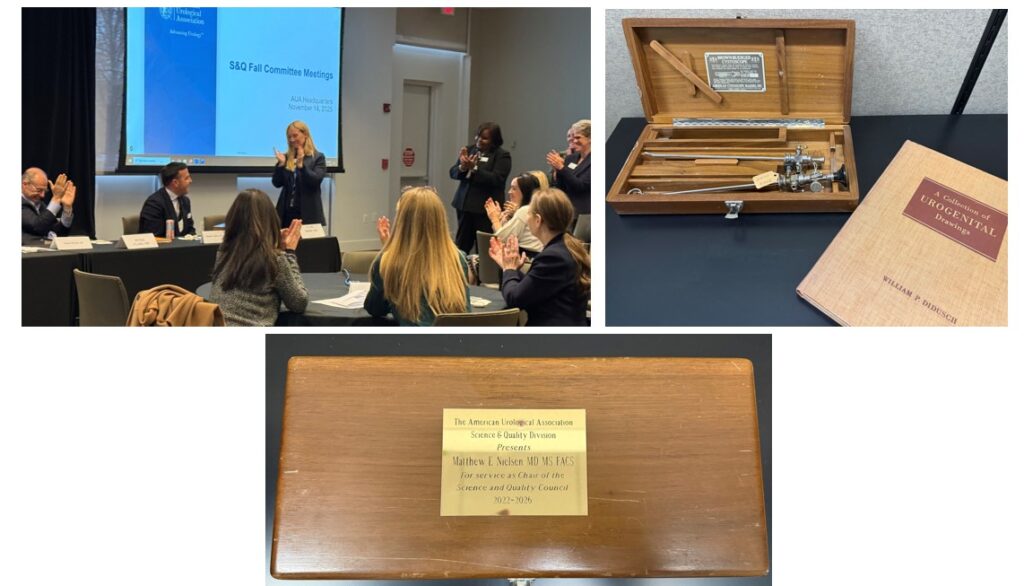
AUA staff recognized Dr. Nielsen’s leadership as Science and Quality Council Chair at the fall 2025 committee meetings. They shared an historic urology text book and cystoscope, now on display in the UNC Urology Department offices.