



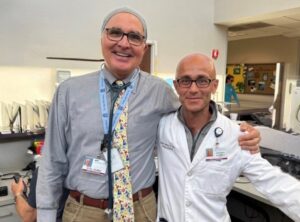
When Hurricane Helene devastated parts of western North Carolina in the Fall of 2024, Dr. Stephen Gamboa swung into high gear, leading a medical team whose responses were so well orchestrated that their work is being held up as an example for other medical professionals who may face similar circumstances.
A Record Breaking Storm
Dark and foreboding clouds filled the sky above UNC Health’s Pardee Hospital in Henderson, N.C., on an otherwise relatively routine morning in late September, 2024. The local community was on alert as hurricane Helene approached, but virtually no one was expecting the unprecedented level of damage the storm would deliver in the area surrounding this otherwise relatively quiet rural community hospital, and in neighboring parts of western N.C.
Experience, Teamwork, and Dedication to the Local Community
Dr. Stephen Gamboa is a UNC School of Medicine 2004 graduate, and a class of 2013 UNC Department of Emergency Medicine (EM) alumni, as well as an Adjunct Associate Professor in the Department, and Emergency Department Director at UNC Health Pardee. He relied on his training and years of hands-on experience when the storm struck. This allowed him to respond quickly and play a pivotal leadership role in coordinating the response of the hospital’s emergency department.
His efforts, and those of his team members, are now featured in both a recent issue of Annals of Emergency Medicine, and a podcast discussion with UNC EM’s Dr. Christina Shenvi.
The peer review article and podcast focus on lessons learned from caring for a rural community during a prolonged infrastructure failure, particularly as it impacted older patient populations.
Serving a largely rural region, the hospital quickly became a critical access point for care as widespread flooding, infrastructure damage, and prolonged outages left an estimated 200,000 residents without reliable access to medical services.
Despite limited structural damage, the loss of electricity, clean water, and, most notably, digital connectivity forced clinicians to rapidly adapt, managing a surge in patient volume while operating without electronic medical records, laboratory systems, or standard communication tools.
Dr. Gamboa, alongside Dr. Paul Chelminski and Dr. Christina Shenvi, captured these experiences in their publication, highlighting both the challenges and innovations that emerged during the crisis.
Clinicians reverted to analog workflows, using paper charting, in-person team huddles, and point-of-care testing, to maintain safe and effective care.
Dr. Paul Chelminski, a UNC Professor of Medicine who helped co-author the journal article, volunteered as a physician at Pardee UNC medical center during the hurricane. Dr. Christina Shenvi, also a co-author for the publication and a leading podcaster, is a Professor of Emergency Medicine in the UNC Department of Emergency Medicine and Adjunct Associate Professor in the UNC Division of Geriatrics.
Creative Problem Solving
Creative solutions extended beyond the hospital walls, including the rapid establishment of a medical device shelter at a nearby high school to support patients dependent on electricity for life-sustaining equipment. These adaptations underscore a central lesson: modern health care systems remain highly vulnerable to disruptions in digital connectivity, even when backup power is available.
The team’s work emphasizes the essential role of rural hospitals as community anchors during disasters. Their findings offer practical guidance for future preparedness, including the need for analog contingency planning, decentralized care models, and investment in resilient communication infrastructure.
As extreme weather events become more frequent, this experience at UNC Pardee highlights both the ingenuity of frontline teams and the importance of preparing health systems for scenarios that challenge the very foundations of modern care delivery.