• GMB/BCB Friday Seminar Series

    Friday – GMB/BCB Seminar Series: Alison Motsinger-Reif

    1131 Bioinformatics Building 125 Mason Farm Road, Chapel Hill, NC, United States

    GMB/BCB Friday Seminar Series The GMB/BCB Friday Seminar Series welcomes Alison Motsinger-Reif, Chief, Biostatistics & Computational Biology Branch and Principal Investigator at the National Institute of Environmental Health Sciences, on Friday, January 30, 2026. Dr. Motsinger-Reif’s talk title is “Gene Environment Interactions in the Personalized Environment and Genes Study”. Dr. Motsinger-Reif is hosted by Samir Kelada, Professor of … Read more

  • GMB Student Seminar Series

    Tuesday – GMB Student Seminar Series: Lerner & Szymanski

    Pagano Conference Room 450 West Drive, Chapel Hill, NC, United States

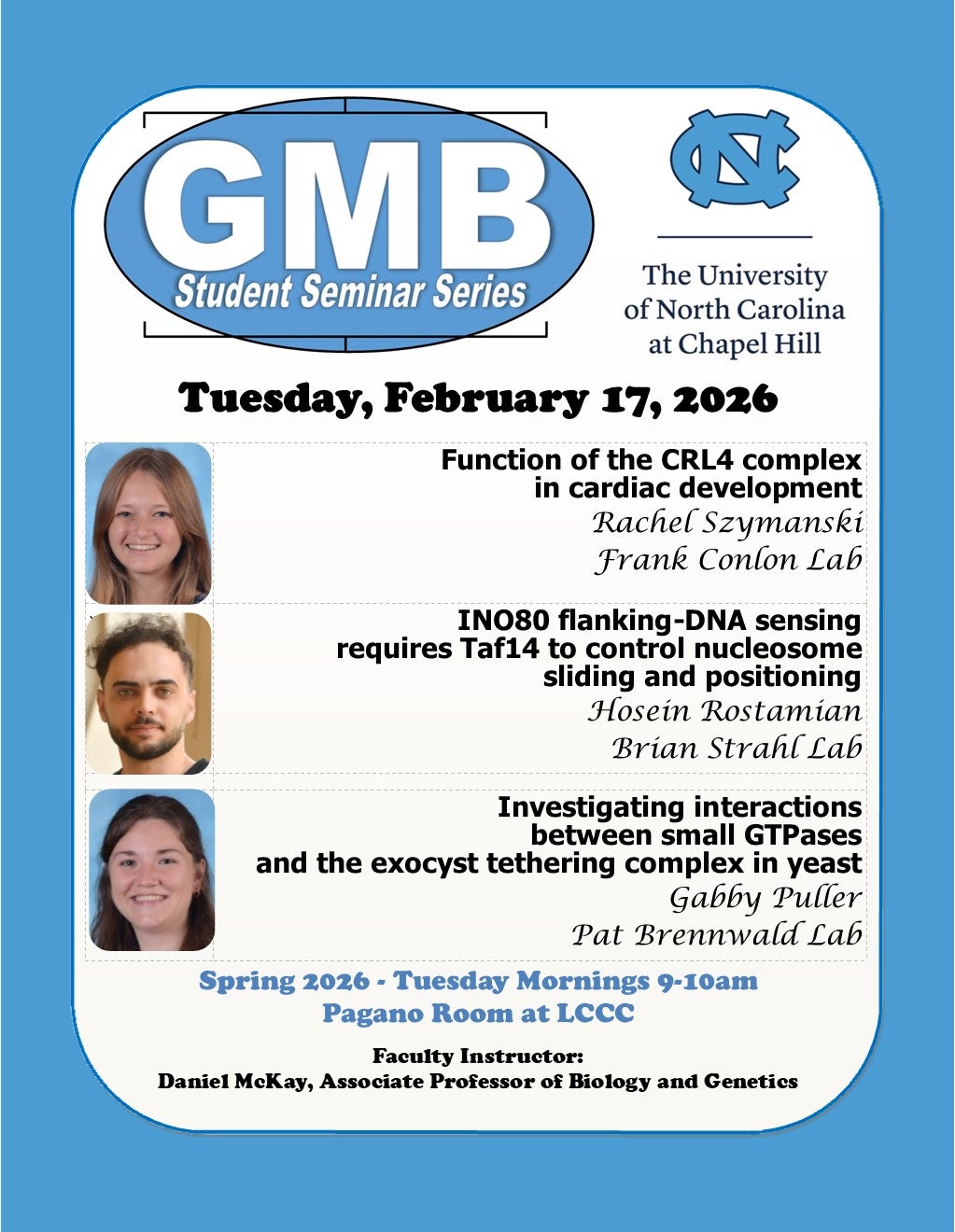
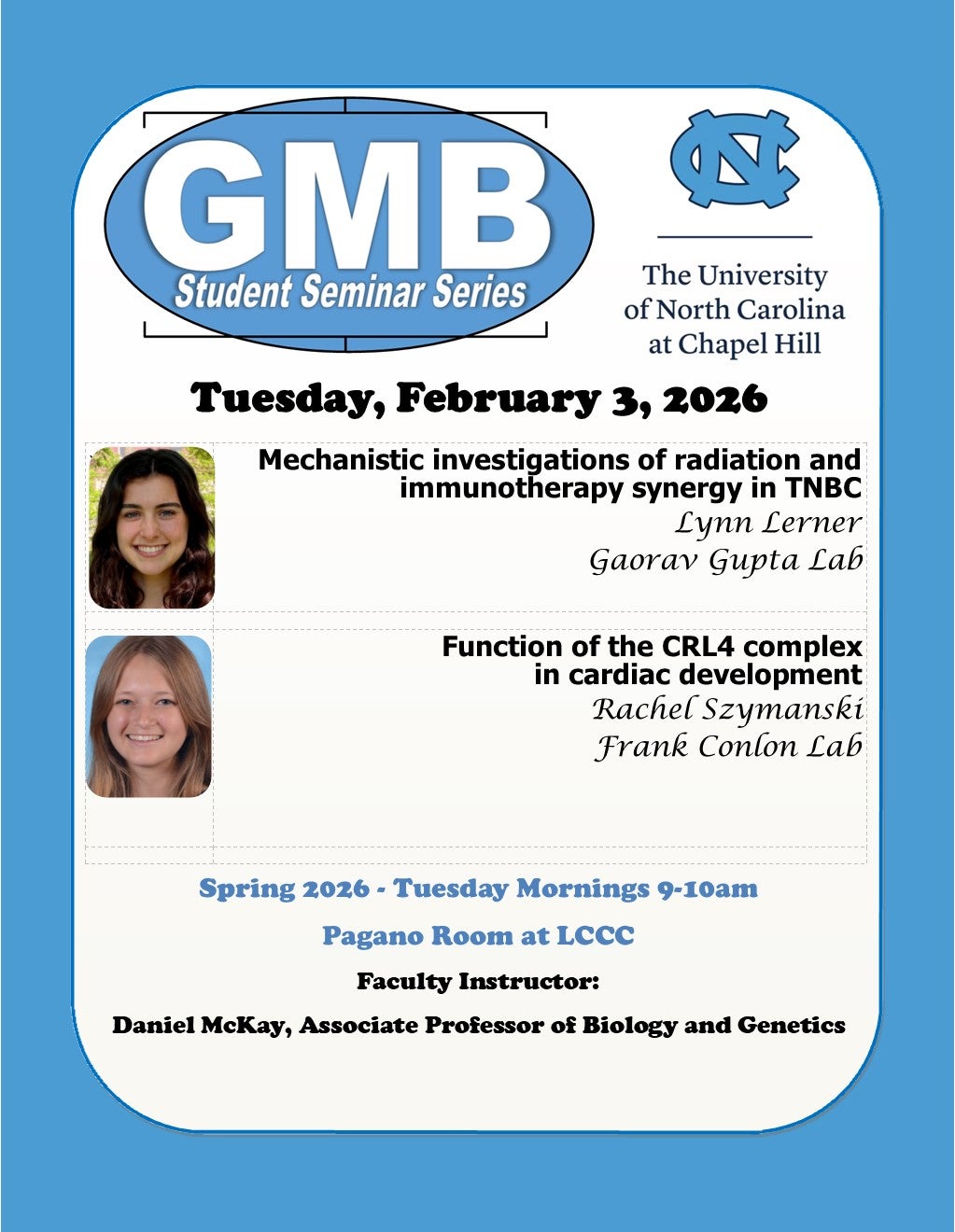
    Genetics & Molecular Biology Student Seminar Series Weekly seminar series featuring talks from the students of the UNC Curriculum in Genetics & Molecular Biology. This week’s speakers are Lynn Lerner from the Gaorav Gupta Lab and Rachel Szymanski from the Frank Conlon Lab.

  • BCB Student Seminar Series

    Thursday – BCB Student Seminar Series: Gillman & Daigle

    1131 Bioinformatics Building 125 Mason Farm Road, Chapel Hill, NC, United States

    Bioinformatics & Computational Biology Student Seminar Series Weekly seminar series featuring talks from the students of the UNC Curriculum in Bioinformatics & Computational Biology. This week’s speakers are Madeline Gillman from the Laura Raffield Lab and Austin Daigle from the Parul Johri and Dan Schrider Labs.

  • Genetics Research Colloquium

    Wednesday – Department of Genetics Colloquium: Gregory Smith

    1131 Bioinformatics Building 125 Mason Farm Road, Chapel Hill, NC, United States

    Genetics Research Colloquium The UNC Department of Genetics Research Colloquium welcomes Gregory Smith, Assistant Professor of Genetics and Co-Director, UNC Pulmonary and Inhalation Research Core, on Wednesday, February 18, 2026. From the genomes of the Collaborative Cross: a new mouse model for ozone health effects research