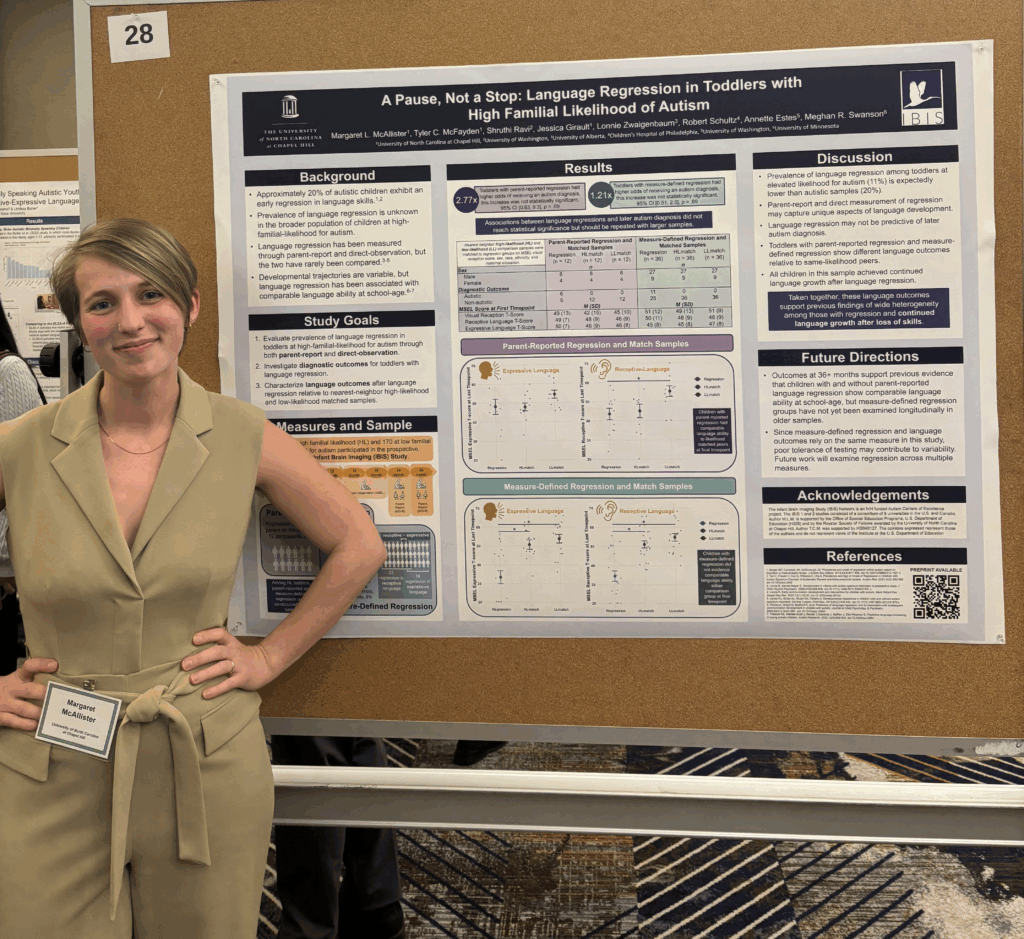
 Mags McAllister is a third-year graduate student in the Speech and Hearing division in the Department of Health Sciences at UNC’s School of Medicine, where she works with Dr. Clare Harrop on several autism-focused studies. One of the main projects she’s involved in follows children ages 4 to 8 over about two years, tracking their development over time. She also works on studies with older adults, which she especially enjoys because of her background in memory disorders research.
McAllister began her undergraduate career at the University of North Carolina at Chapel Hill as a psychology and neuroscience major. When she first came to UNC, she believed she would pursue an environmental science degree until she took a first-year seminar that changed her perspective. Growing up in a small town in North Carolina with limited course offerings, she had never considered that studying human behavior could be a career. The course introduced her to psychological research and the idea that she could ask questions and answer them with data. This was the experience that ultimately set her on a new path.
Before coming to UNC for graduate school, McAllister completed her undergraduate degree and worked in ABA therapy for a period of time. In this role, she provided in-home therapy with mostly non-speaking autistic children, helping them build adaptive and communication skills. This experience sparked her interest in autism and led her to the Duke Center for Autism and Brain Development Research (DCABD), where she worked for two years on a study focused on early detection and early intervention.
From there, she moved to Duke’s Neurology department, where she worked with a mentor conducting aging research using methods she was excited to learn, including MRI and transcranial magnetic stimulation (TMS). In this role, she gained hands-on experience working with older adults and developed skills in processing and analyzing neuroimaging data.
At UNC, McAllister has continued to engage with this type of work through the IBIS project at the Carolina Institute for Developmental Disabilities (CIDD). There, she has collaborated with many researchers including Mark Shen, PhD, Jessica Girault, PhD, and Meghan Swanson, PhD, as part of the multi-site study. Through these opportunities, she has been able to contribute to a wide range of projects.
The work she presented is based on the IBIS cohort, a prospective longitudinal study that follows children from around three to six months of age until they reach the typical diagnostic window for autism between ages two and five. To increase the likelihood of observing autism, many of the participants are younger siblings of autistic children, though children without that likelihood are also included.
McAllister became interested in language regression, a phenomenon in which parents report that their child has stopped saying words they previously produced. This can be a very alarming experience for families, often making it feel as though developmental progress is not permanent.
To better understand this, she examined two groups: children whose parents reported language loss and children who showed measurable declines in standardized language assessments over time. These assessments occurred about every six months, so even small decreases represented meaningful changes. Interestingly, the two groups barely overlapped at all, suggesting they reflect different experiences.
She then looked at outcomes later in childhood and found that children in the parent-reported group were generally catching up to their peers. In contrast, children who showed measurable declines in their scores continued to struggle with language development over time.
These findings suggest that language regression may not be a single phenomenon, but instead reflect two different patterns. Parent-reported regression may represent broader differences in early social communication, while measurable declines in language scores may indicate more persistent language challenges. This distinction may help guide different types of support, such as broader interventions like ABA and occupational therapy versus more targeted speech-language services.
“It’s really rewarding to watch these kids grow and change and get to measure that change and share that back with families. It’s just really special,” said McAllister.