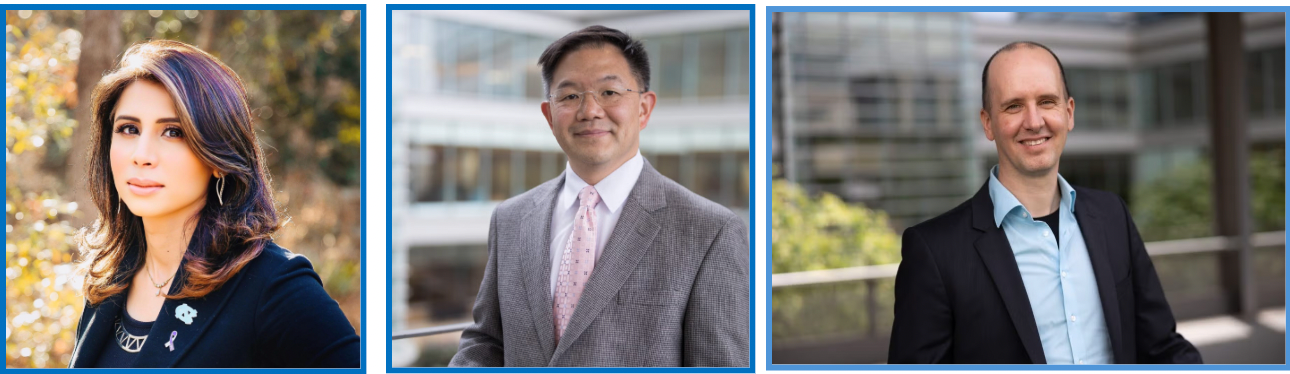
A rheumatologist, neuroradiologist, and computer scientist have joined forces to blend medical expertise with AI/machine learning to reimagine the future of lupus diagnosis and care. Saira Sheikh, MD, the Linda Coley Sewell Distinguished Professor of Medicine at UNC and Chair of the Lupus Clinical Investigators Network, teamed up with Yueh Lee, MD, PhD, FACR, Co-PI, Professor and Vice Chair of Translational Research in Radiology at UNC and Marc Niethammer,PhD, Research Professor in Computer Science at UNC Chapel Hill to develop an efficient diagnosis of lupus through multimodal analyses. Their project is entitled Automated Reasoning & Interpretation for Early Lupus Detection (ARIEL).
Multimodal approaches for diagnosing autoimmune diseases are nascent, and most focus only on omics data or electronic health records, ignoring other sources of informative patient data. According to Dr. Saira Sheikh, who is the Lead Principal Investigator of the project, “Our approaches will significantly advance multimodal machine learning in general, and for autoimmune diseases specifically, tackling a highly relevant disease like lupus and allowing us to identify and accelerate care for those at greatest risk for poor outcomes.”
The team believes that their approach could be transformative by improving the diagnostic abilities of primary care physicians as well as subspecialists, to enable better health outcomes for patients far and wide. While the focus is on lupus as the driving biological problem, the computational approaches they aim to develop will be applicable to other autoimmune diseases and beyond. Artificial Intelligence has the potential to revolutionize the early diagnosis of lupus by analyzing vast amounts of clinical and imaging data to detect subtle patterns that may be missed by traditional diagnostic methods.
“This grant is truly a multidisciplinary and collaborative team effort, bringing together our exceptional clinical and technical teams. Given the complexity and variability of lupus symptoms, which often mimic other conditions, AI-powered tools such as machine learning algorithms and predictive models can help identify early indicators of the disease with greater accuracy and speed. This can lead to reduced misdiagnosis rates, faster interventions, and improved long-term outcomes for patients. As AI continues to evolve, its integration into clinical workflows holds promise for transforming lupus diagnosis from a lengthy, uncertain process into a more precise and timelier one”, remarks Dr. Sheikh
A strength of this project is the incorporation of community partner engagement throughout every step of the process, ensuring that the tools & data outputs are grounded in real-world needs & applications, shaped by those who receive & deliver care.
Other key members of the Sheikh Research team on this project that bring extraordinary experience and expertise are Tessa Englund, PhD, MPH, (Senior Research Scientist) and Claire Timon, MS (Social Clinical Research Assistant). Becki Cleveland, PhD, Director of Biostatistical Operations at NC TraCS is also a key project partner. The technical team also includes an exceptional group of computer scientists at UNC. Dr. Mohit Bansal, PhD, John R. & Louise S. Parker Distinguished Professor at UNC brings expertise in natural language processing and multimodal machine learning. Hongtu Zhu, PhD, Kenan Distinguished Professor, brings expertise in statistical learning, medical image analysis, precision medicine, biostatistics, artificial intelligence, and big data analytics. Junier Oliva, PhD provides strong machine learning experience with a focus on understanding data at an aggregate, holistic level. Tianlong Chen, PhD brings expertise in building accurate, trustworthy, and efficient machine learning systems. Kelyne Kenmogne (UNC renci) is the project manager.
Year #2 of this award also incorporates additional project partners focused on developing federated learning approaches for cancer clinical trial matching. This includes Ghulam Rasool, PhD at Moffitt Cancer Center, Hongfang Liu, PhD and Liwei Wang, PhD at The University of Texas Health Center at Houston, Wei Zhang, PhD at Atrium Health Wake Forest Comprehensive Cancer Center and Jihad Obeid, MD and Paul Heider, PhD at the Medical University of South Carolina.