Mental Health & Wellness Resources
Emergency Resources
Counseling and Psychological Services: https://caps.unc.edu/
If this is a life-threatening medical or mental health emergency:
• Call 911
• Visit the nearest hospital emergency department
To speak to someone now about an urgent emotional or mental health concern:
• Call CAPS 24/7 at 919-966-3658
• Call or text 988 Suicide and Crisis Lifeline
• Text START to the Crisis Text Line at 741-741
More numbers you can call to talk to a counselor (external to UNC)
- Talkspace – 24/7 access, no appointments or commuting needed, can switch therapists at no extra costs, flexible plans (not instant — need to register)
- BetterHelp – World’s largest counseling service, 100% online, can do messages, chat, phone, video sessions – (not instant — need to register)
- Psychology Today – find a therapist, how to work remotely, and more
- List of Local Resources for Mental Health, Substance Use Disorders & Suicide Prevention (external and within UNC) [pdf]
- APEX Cert – List of Mental Health Resources for Emergencies & Crises, Mobile Crises Services and Coping With COVID-19 [pdf]
Mental Health Resources
We believe scientists must prioritize mental health and wellbeing in order to be successful. The Department of Pharmacology recognizes and understands that graduate school can bring increased pressure and stress that can be difficult to navigate. Students, faculty, and staff should be aware that we care deeply for everyone in our Pharmacology family and are actively working to promote a healthy environment. With this, the following is a list of UNC-based resources you might wish to explore:
Services/Offices at UNC

-
HEELS Care Network: https://care.unc.edu
- The Heels Care Network is a gateway for mental health and wellness resources for everyone on campus: to find a support group, learn strategies for mental health, connect with training and advocacy organizations, or find wellness events on campus. The Heels Care Network also includes support resources for community members who are not doing well and are seeking immediate help.

Counseling and Psychological Services (CAPS): https://caps.unc.edu/
- First time visits do not need to schedule an appointment and can simply walk in to CAPS during the following days and times:
- Monday-Friday 9:00 a.m.-12:00 p.m., 1:00 p.m.-4:00 p.m.
- Urgent Needs: Monday-Friday 8:00 a.m.-5:00 p.m.
- One-on-one counseling and guidance is available for students and post-docs. Click here for next steps.
- 24/7 Phone Line: 919-966-3658
-
- CAPS is located in the James A. Taylor Building on the 3rd floor. This building is between Kenan Stadium and the Hospitals, off of Emergency Room Drive. For specific directions from multiple campus locations, see this website: https://caps.unc.edu/about-us/contact-us
- If you know someone in need of CAPS, it is helpful to walk with them to this office. This will not only ensure they reach their destination, but can also help reduce any potential anxiety they may have.
- Most services at CAPS are already paid for with the health fee and offered at no further cost to the student, post-doc, or partner. This includes initial assessments, brief therapy through CAPS or an online provider, group therapy, referral coordination for a community provider, academic interventions, the Multicultural Health Program, embedded therapist services, crisis intervention, and outreach.
- CAPS is located in the James A. Taylor Building on the 3rd floor. This building is between Kenan Stadium and the Hospitals, off of Emergency Room Drive. For specific directions from multiple campus locations, see this website: https://caps.unc.edu/about-us/contact-us
-
Student Wellness Coaches for School of Medicine students: https://www.med.unc.edu/wellness/appointments/
- PhD candidates who entered UNC through BBSP or the MD/PhD programs can email Zoe Silverman (LCSW) at zoe.silverman@unc.edu to schedule an initial assessment.
- Zoe is a licensed clinical social worker and provides one-on-one counseling to PhD students at the School of Medicine.

-
Graduate Student Orientation Site: https://gradschool.unc.edu/events/orientation/#virtualorientation
- The Graduate Student Orientation site has lots of information and resources, along with videos to introduce those to you

-
Office of the Dean of Students: https://odos.unc.edu/student-support
- The Office of the Dean of Students is committed to providing essential education, programs and services to support students’ academic, personal and professional development. Our staff works with faculty, staff, and students across campus, as well as with parents, town leaders and community members to reach this goal,

-
University Ombuds Office: https://ombuds.unc.edu/
- The University Ombuds Office is a safe place where all Carolina staff, faculty, students and administrators are welcome to come and talk in confidence about any campus issue, problem, or dispute. Our office supplements, but does not replace, the University’s formal channels, such as the grievance policy. Contact us as a first step, or as a last resort, or anywhere along the way. Come and share your concerns, evaluate your situation, and plan your next step—if you want to take a next step. Use of our services is voluntary and free. Visitors will find our office a safe place to discuss their concerns, no matter how large or small.
- Ombuds Brochure

-
Safe at UNC: https://safe.unc.edu/
- This website is the main portal for students, faculty, staff, and visitors at UNC- Chapel Hill to obtain information about prevention and help regarding issues of discrimination, harassment, sexual assault or sexual violence, interpersonal violence, and stalking.

-
The University Compliance Office https://eoc.unc.edu/
-
The University Compliance Office is dedicated to the well-being and success of Carolina’s most valuable asset— its people. If ever you find that certain events or experiences have unfairly affected your academic or professional success, we’re here to help.
-
-
-
Accommodations Accessibility Resources and Services (ARS): https://eoc.unc.edu/accommodations/
- University Compliance Office (UCO) assists the University community with disability, pregnancy and religious accommodation requests, including auxiliary aids and services. UCO also offers training and consulting services to address any questions or accessibility needs.
-

-
Student Wellness: https://studentwellness.unc.edu/
- Student Wellness is a health education and health promotion office whose work is rooted in Public Health science, with a focus on environmental change strategies.

-
Total WellBeing – Employee Assistance Program (EAP) (Available to permanent UNC employees and their dependents, including postdocs): https://hr.unc.edu/wellness/employee-assistance-program/
- From financial pressures to workplace stress and family issues, life can be challenging. If you need help, the UNC-Chapel Hill Employee Assistance Program (EAP) is available. The EAP is a confidential counseling and resource program that is designed to help University employees and their families deal with both personal and work-related concerns.
- Contact for UNC Total WellBeing: totalwellbeing@unc.edu
- Trained counselors are available by phone 24 hours a days, seven days a week through the University’s EAP offered by ComPsych. You or your family members may call the EAP at anytime. Call ComPsych toll-free 24 hours a day at 877-314-5841.
- You can also visit their online resources at www.guidanceresources.com.
- At the home page, if you are a first time user, click “Register”
- At the top of the next page, enter the Organization Web ID TARHEELS and complete the remainder of the boxes with your desired username and password and other requested information
- On subsequent visits, use the username and password you established on your first visit to access resources
Mental Health & Wellness
During PhD and After
For Graduate Students
-
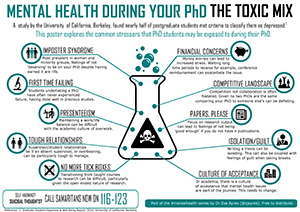
The Toxic Mix During Your PhD:
- The stressors & the strains…what might make management of your mental health more difficult.
Open pdf
Accessible web page for The Toxic Mix During your PhD
(Our thanks to Dr. Zoë Ayres, @ZJAyres, who developed and shared this poster.) - Common stressors discussed on the poster include: imposter syndrome, first time failing, financial concerns, competitive landscape, presennteeism, papers please, tough relationships, isolation/guilt, no more tick boxes, and of acceptance.
- The stressors & the strains…what might make management of your mental health more difficult.
-
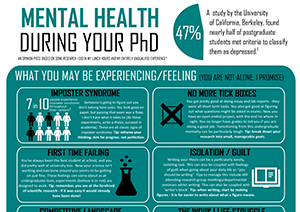
Mental Health During Your PhD:
- What you might experience or feel.
Open pdf
Accessible webpage for Mental Health During Your PhD
(Our thanks to Dr. Zoë Ayres, @ZJAyres, who developed and shared this poster.) - This poster discusses what you may be experiencing/feeling which can include: imposter syndrome, no more tick boxes, first time failing, isolation/guilt, competitive landscape, the work/life struggle.
- It also includes warning signs to be aware of in those around you who may be struggling which include: increased drinking, increased or decreased eating, working long hours, being absent, joking about suicide, and looking disheveled.
- It also includes some ways to manage your mental health and wellbeing such as: seek medical advice, take some time out, focus on you, request counseling, talk to your supervisor, talk to your peers/postdocs, create manageable chunks, and read literature.
- What you might experience or feel.
-
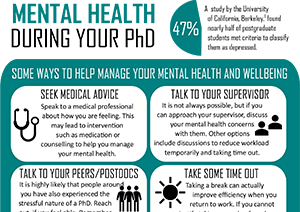
Some Mental Health Tips During Your PhD:
- Some ways to help manage your mental health and wellness.
Open pdf
Accessible webpage for Some Mental Health Tips During Your PhD
(Our thanks to Dr. Zoë Ayres, @ZJAyres, who developed and shared this poster.) - The poster’s eight tips for how to manage your mental health during Covid-19 include: seek medical help, talk to your supervisor, talk to your peers/postdocs, focus on you, create manageable chunks, request counseling, read literature.
- Some ways to help manage your mental health and wellness.
-
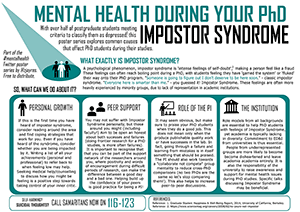
Shining a Spotlight on Imposter Syndrome:
- What we can do, what our peers can do to support, the role the PI plays, and what universities can do to support.
Open pdf
Accessible webpage for Shining a Spotlight on Imposter Syndrome
(Our thanks to Dr. Zoë Ayres, @ZJAyres, who developed and shared this poster.) - This poster discusses imposter syndrome and what we can do about it. Imposter syndrome is ‘intense feelings of self-doubt’, making a person feel like a fraud. These feelings can often reach boiling point during a PhD. Things we can do about it include: how to deal with it on a personal level, peer support, role of the PI and the institution.
- What we can do, what our peers can do to support, the role the PI plays, and what universities can do to support.
For Postdocs

-
The Perils of a Postdoc:
- A foray into the fact that mental health issues do not stop at the PhD level. The strains and stressors continue into the postdoc environment as well.
Open poster
Accessible webpage for The Perils of a Postdoc
(Our thanks to Dr. Zoë Ayres, @ZJAyres, who developed and shared this poster.) - Common stressors included on the poster are: compete or perish, family commitments, idea generation, need for independence, position instability, teaching experience, global challenges, altac sell-out, a star is born, burnout or drop out, and don’t get stuck.
- A foray into the fact that mental health issues do not stop at the PhD level. The strains and stressors continue into the postdoc environment as well.
For Undergraduates
-
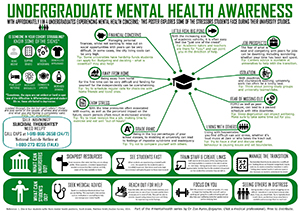
Undergraduate Mental Health Awareness:
- With approximately 1 in 4 undergraduates experiencing health concerns, this poster explores some of the stressors students face during their university studies.
Open poster
Accessible webpage for Undergraduate Health Awareness
(Our thanks to Dr. Zoë Ayres, @ZJAyres, who developed and shared this poster.) - Common stressors students experience during their studies can include: financial concerns, away from home, little fish in a big pond, exam stress, grade panic, living with others, fear of missing out, isolation and job prospects.
- it also includes signs that others around you are struggling, which can include: being absent, slipping grades, social withdrawal, disheveled appearance, poor sleep patterns, increased irritability, changes in appetite and increased drinking.
- Among things students can do are: seek medical advice, reach out for help, focus on you, seeing others in distress.
- Among things institutions can do are: signpost resources so students know what help is available, see students fast, train staff and create links, and manage the transition.
- With approximately 1 in 4 undergraduates experiencing health concerns, this poster explores some of the stressors students face during their university studies.
For Institutions
-
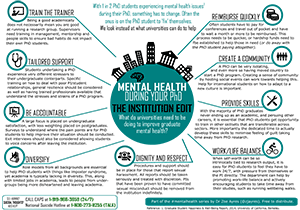
The Institution Edit:
- What can universities do to improve graduate mental health? What are the active steps to make mental health better for PhD students? The narrative that it’s the students’ problem and their problem only is wrong and misleading.
Open pdf
Accessible webpage for The Institutional Edit
(Our thanks to Dr. Zoë Ayres, @ZJAyres, who developed and shared this poster.) - The poster explores things universities can do to improve graduates’ mental health, which include: train the trainer, tailor support, be accountable, diversify, dignity and respect, work/life balance, provide skills, create a community, and reimburse quickly.
- What can universities do to improve graduate mental health? What are the active steps to make mental health better for PhD students? The narrative that it’s the students’ problem and their problem only is wrong and misleading.

-
Stress First Aid:
- Stress First Aid
- Stress First Aid 2
- The SOM Wellness group and holds monthly meetings and training that then can be offered to Departments within the SOM.
Training Opportunities
(Open to Students, Postdocs, Faculty, and Staff)

-
Mental Health First Aid Training: https://www.mentalhealthfirstaid.org/
- Mental Health First Aid is an 8-hour training that will give students, staff, and faculty the skills to help someone who is developing a mental health problem or experiencing a mental health crisis. Just as CPR training helps a layperson without medical training assist an individual following a heart attack, Mental Health First Aid training helps a layperson assist someone experiencing a mental health crisis.
Student Groups/Organizations
-
PhD Balance: https://phdbalance.com/
- This organization was founded by current Microbiology and Immunology student, Susanna Harris.
- You can be productive in academia, work on and complete a graduate degree, AND struggle with your mental health. Our mission at PhD Balance is to provide honest stories from people like you and curate resources with advice about strategies, yoga, mindfulness, and more.
-
Carolina Recovery Program: https://studentwellness.unc.edu/programs/alcohol-drug-programs/carolina-recovery-program
- To encourage a community that supports continued recovery, academic excellence, and a commitment to serving the greater UNC community. The Carolina Recovery Program provides each student a customized success plan, staff and peer support, and proactive recovery focused programming. Their goal is to enable students to enjoy a normal substance-free collegiate experience while excelling at UNC-CH. They believe this recovery program experience will reconnect emerging leaders with their passion to make a difference in the world.

-
Stigma Free Carolina: http://stigmafree.unc.edu/
- Stigma Free Carolina is a UNC community campaign aimed at reducing stigma toward mental health concerns and treatment. By accurately defining mental health, educating the community, and dispelling negative or false beliefs about mental health and its treatment we can help everyone be their best selves and reach their full potential.
Additional Resources
- Concerning Behavior Response Guide
- Faculty Guide for Mentoring a Student with a Mental Health Issue
- Faculty Guide for Students of Concern
- UNC Mental Health Task Force Report
- “Get online to support wellbeing of graduate students” – eLIFE Article by Susanna L. Harris (M&I Student) and Liesl A. Krause
- Anxiety and stress management training
- Stress and anxiety and meditation and mindfulness resources