Acute Care FOURC model
The Acute Care FOURC model is designed to establish early communication and participation for patients with neurologic communication disorders. Speech, language, and cognition abilities often evolve rapidly during acute care. Patients and family have significant information and communication needs, while SLPs have limited time to work with each person. The model operates through three intervention prongs to maximize impact. The same four goals are used for all patients and they are graded on a scale from 0 to 4 for degree of initiative and comprehensiveness. For most patients, the goal is a rating of 3 at the time of discharge. See resources below. A tutorial is under development.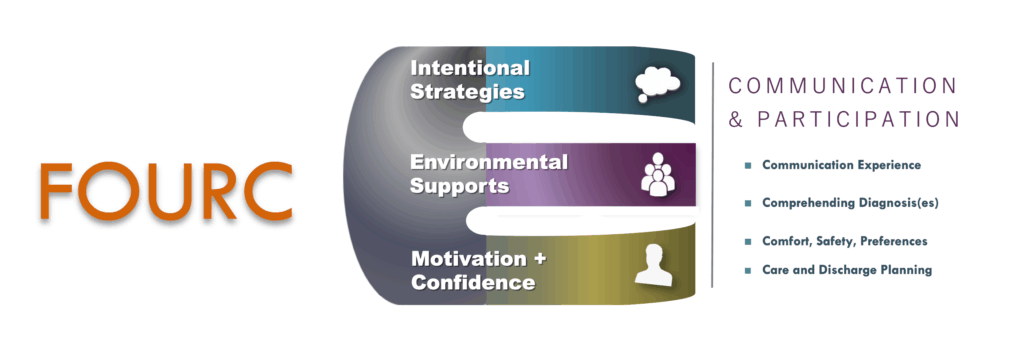
Three Prongs
- Intentional Strategies
- Environmental Supports
- Motivation and Confidence
Four Goals
- Communication Experience
- Comprehending Diagnosis(es)
- Comfort, Safety, Preferences
- Care and Discharge Planning
Resources for SLPs
- FOURC Rating scale – Rating scale for outcome measurement
- Documentation template
- My Story – Visual for talking about hospital admission
- Info In & Out handout – Checklist for communication supports
- Aphasia Institute: talking to your family member – Information for family members
- CPT resources to use with families – Communication training resources for families
- Black & White body – Visual for referring to parts of body
- Talking about diagnoses – Visual for talking about diagnoses
- What is aphasia? – Brochure for talking about aphasia
- What is a stroke? – Brochure for talking about stroke
- What is dysphagia? – Brochure for talking about dysphagia
- What is BI? – Brochure for talking about brain injury
- Talking about preferences and precautions – Checklist for comfort, safety, preferences
- Call light – Visual for explaining the call light
- Weight bearing precautions – Visual for explaining weight bearing precautions
- IV precautions – Visual for explaining IV precautions
- NGT precautions – Visual for explaining feeding tube precautions
- Safe swallow – Visual for explaining safe swallow
- Preferences_Line Drawings – Visual for comfort, safety, preferences (drawings)
- Preferences_Photos – Visual for comfort, safety, preferences (photos)
Discharge planning – Visual for topics around discharge planning
References:
Corwin M, Haley KL, Potocnik A, Reichneker C, & Tillson A. (2025). You can do that in a hospital? Using the acute care FOURC model in treatment. Seminar presented at: American Speech-Language Hearing Association Annual Convention. Washington DC.
Potocnik A, Corwin M & Haley KL (2025, May). Acute care aphasia assessment & intervention: Applying the FOURC acute care model. Roundtable presented at: Clinical Aphasiology Conference, Albuquerque, NM.
Corwin M & Haley KL. (2025, May). Aphasia Assessment and Treatment in Acute Care Settings: Using the FOURC Model. Seminar presented at: Texas Speech-Language Hearing Association, San Antonio, TX.