
Broadly defined as a group of eye-drying disorders, ocular surface disease (OSD) in mild form affects a high percentage of adults and can be medically managed by comprehensive eye care specialists. When acute ocular surface damage causes scarring, swelling, thinning, or perforation, corneal transplantation has long served as the advanced OSD procedural go-to for corneal and ocular surface subspecialists to structurally repair the outer eye.
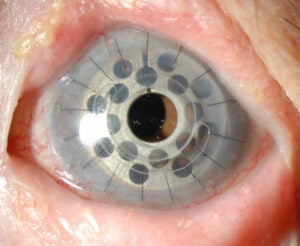
Bio-engineered corneal implants have emerged as a procedural solution when human tissue grafting is unviable or likely to fail in cases of irreversible corneal blindness and severe deterioration of the outer eye. As corneal tissue donor shortages rise, the field of complex ocular surface care has increasingly turned to bio-engineered, artificial cornea implantation (keratoprosthesis). In patients who have experienced extensive corneal scarring and who carry a high risk of donor tissue rejection in conventional transplantation, keratoprosthesis has paved the way for swift restoration of eyesight and reduction of ocular pain.
On April 14th, 2026, UNC Professor of Ophthalmology Mohammad Soleimani, MD, FICO, successfully performed UNC Hospitals’ (Hillsborough Surgical Services) first artificial cornea implantation. This achievement marked not only an institutional milestone in complex ocular surface care at UNC Hospitals. It also reinforced UNC Health’s patient care mission of offering crucial treatment alternatives to those with limited options.
For decades, Dr. Soleimani has helped shape medical practice and translational research in corneal and ocular surface disease. Practicing at top-tier U.S. and global institutions, the world-renowned physician scientist has integrated emerging surface protection and procedural interventions into treating patients coping with severe ocular surface disease.
In early 2026, Dr. Soleimani identified a patient with Stevens–Johnson syndrome, an acute disorder causing ocular mucous membrane breakdown, as an ideal candidate for carrying out UNC Hospitals’ first artificial cornea implantation. At UNC Hospitals Hillsborough Surgical Services unit, Dr. Soleimani was aided by three teammates in the OR — UNC Ophthalmology’s 2025-2026 Corneal and External Disease Fellow Mubarik Mohamed, MD, UNC Health Certified Surgical Technologist Laura Cybulski, CFA, CST III, and UNC Health Clinical Nurse II Katie Stainback, RN, ADN, — in successfully performing this successful “first” at UNC Health in complex ocular surface care.
Dr. Soleimani noted: “Keratoprosthesis and ocular bioengineering offered a patient who was suffering medication-resistant, eye-drying destruction of the outer ocular surface a critical opportunity to experience visual rehabilitation. This singular procedure immensely decreased this individual’s pain and gave him stable, immediate optical clarity, despite having experienced extensive corneal scarring. The successful implementation of artificial cornea implantation at UNC reflects our commitment to advancing complex corneal and ocular surface care and expanding access to cutting-edge surgical solutions for the most challenging cases.
The goal of my practice is to improve severe corneal disease outcomes in patients and to educate next-generation eye specialists on surgical techniques our subspecialty has developed in complex ocular surface care. This milestone allows our teaching faculty to introduce our residents and fellows to innovative procedures that have emerged in complex anterior segment reconstruction.”
PHOTO (L to R): UNC Hospitals Hillsborough Surgical Services Certified Surgical Technologist Laura Cybulski, CFA, CST III, UNC Health Clinical Nurse II Katie Stainback, BSN, RN, UNC Professor of Ophthalmology Mohammad Soleimani, MD, FICO, and UNC 2025-2026 Corneal and External Disease Fellow Mubarik Mohamed, MD.