John C Olsen, PhD
| Research | Biosketch | Personnel | Contact |
Research Focus
The main focus is to develop lentiviral vectors as vehicles for delivering therapeutic genes to the lung for treatment of cystic fibrosis and other diseases. We have developed a novel lentiviral-based gene delivery system based upon equine infectious anemia virus (EIAV) that can efficiently transfer genes to human cells. The main advantage of EIAV-based vectors over conventional retroviral vectors is that EIAV vectors transfer and express genes in both dividing and non-dividing cells. Thus, these vectors will have utility in transferring genes to slowly growing cells of the respiratory epithelium.
The overall goals of the lab are two-fold. First, fundamental aspects of lentiviral vector biology including interactions of the vector with host cells are being studied in order to optimize gene transfer efficiency and expression. This will allow the manipulation of the vector system to achieve safe and efficient use in the clinic. Second, the knowledge of lentiviral vector biology is being exploited to address issues important for treatment of specific diseases. Recent progress in lung gene transfer has been made by using the envelope proteins of influenza virus to target therapeutic genes to the epithelial cells of the respiratory epithelium.
![]() | |
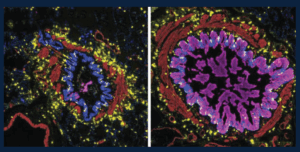
| One approach for testing the ability of new vector constructs to transfer genes to the airways is to study gene transfer of a firefly luciferase reporter gene to the nasal epithelium of mice. The figure shows imaging of firefly luminescence following lentivirus-mediated gene transfer to the nose of 4 week-old-mice. The replication defective lentivirus gene transfer vector is based on equine infectious anemia virus and contains influenza virus coat proteins to mediate entry into the nasal epithelium. | An important goal of cystic fibrosis gene therapy is to efficiently deliver normal CFTR cDNA to the respiratory epithelium of the lungs of CF patients. In one approach, we have been developing methods for delivering lentivirus vectors to the lung. In the experiment shown in the figure, a lentivirus encoding a lacZ-reporter gene was delivered to four-week-old mice by nasal inhalation. The figure shows extensive lacZ gene expression four weeks later, as visualized by X-Gal staining of a section from the left lobe of the lung. |
[top]
Biographical Sketch
John C Olsen, PhD, Associate Professor of Medicine
Education
(1974) B.S., Oregon State University, Corvallis, Biochemistry.
(1982) Ph.D., University of Montana, Missoula, Chemistry.
(1982-1990) Research Associate (Post-Doc), University of North Carolina at Chapel Hill, Retroviruses (trained with Dr. Ronald Swanstrom), UNC Lineberger Comprehensive Cancer Center).
Professional Experience
(2002-present) Associate Professor, Cystic Fibrosis/Pulmonary Research and Treatment Center, University of North Carolina at Chapel Hill School of Medicine.
(1993-2001) Research Assistant Professor, Cystic Fibrosis/Pulmonary Research and Treatment Center, University of North Carolina at Chapel Hill School of Medicine.
(1990-1993) Research Associate, UNC Lineberger Comprehensive Cancer Center, University of North Carolina at Chapel Hill School of Medicine.
Committees/Review Boards
(2007-present) Scientific Review Board Member, NHLBI Gene Therapy Resource Program.
(2002-present) Member, University Safety and Security Committee, University of North Carolina at Chapel Hill.
(2001-present) Chair, UNC Institutional Biosafety, Committee University of North Carolina at Chapel Hill.
(1998-2000) Member, UNC Institutional Biosafety Committee, University of North Carolina at Chapel Hill.
(1998-2007) Scientific Review Board Member, National Gene Vector Laboratories.
Honors and Awards
(1984-1986) Postdoctoral Fellowship from the Leukemia Society of America.
(1977-1978) Awarded University of Montana Bertha Morton Scholarship for most outstanding graduate student in Chemistry.
(1973) Awarded National Science Foundation Undergraduate Research Participation Program Summer Stipend, Oregon State University.
Publications
Please see Pubmed feed in the righhand column for links to current publications.
[top]
Laboratory Personnel
![]() | ![]() |
| John C Olsen, PhD, Associate Professor of Medicine | Manij Patel, PhD, Research Associate |
Contact Information
7103 Thurston-Bowles Bldg.The University of North Carolina at Chapel Hill
Campus Box #7248
Chapel Hill, NC 27599
Phone: (919) 966-6768
Fax: (919) 966-5178
Email: olyunc@med.unc.edu
[top]