Blood Collection
The Preclinical Research Unit (PRU) technicians are proficient at a variety of blood collection methods in laboratory rodents.
Withdrawal Frequency
While there are several acceptable methods of rodent blood collection, each method has advantages and disadvantages. Chronic blood withdrawal requires strict limits on obtained volumes and careful consideration for study time-points. The PRU can provide whole blood, plasma or serum.
Acute Blood Withdrawal
The maximum allowable amount of blood withdrawn for an acute withdrawal is 1% of the lean body weight.
Chronic Blood Withdrawal
The maximum allowable amount of blood withdrawn for chronic withdrawals is 1.5% of lean body weight within a 14-day period.
More information regarding IACUC guidelines can be found here
Tube Type Selection
Different tests require different tube types. Please consult with PRU Blood Lab staff to determine blood draw volumes and tube types prior to collection, guidelines by test type are included below.
- CBCs require purple EDTA tubes.
- Chemistry samples via PRU require serum, in clean Eppendorf tubes, red, marble, or gold top tubes. Plasma samples are not accepted at this time for rodent chemistry analysis (do not use Blue, Green, Mint, Grey, or Yellow tops).
- Serum requires processing into new tubes prior to submission. If PRU staff are collecting the blood, we will include an hourly charge for this processing time and will drop samples off to our Blood Lab directly.
- Coagulation profiles require Blue Top 3.2% Sodium Citrate Tubes.
- All tubes should be sized appropriately to the volume of blood that they’re collecting (e.g. collecting 100 uL of blood in a 1000 uL tube can lead to spurious results from excess anticoagulant)!
Methods of Blood Collection
Submandibular
Submandibular bleeds are an easy way to obtain blood quickly from an awake mouse. A lancet is used to puncture the superficial temporal vein. A volume over 100ul is easily obtained.

Tail Nick
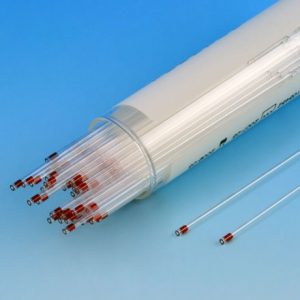
Tail Nick bleeds are best for small volume serial bleeds. A large gauge needle or lancet is used to puncture the vein and blood is collected in micro capillary tubes.
Retro-Orbital
Retro-orbital or orbital sinus/plexus bleeds require scientific justification and approval through the IACUC. There are very strict requirements for timing and number of bleeds that can be performed. PRU technicians are skilled to perform retro-orbital bleeds in both anesthetized and un-anesthetized (exception required) laboratory mice.
Cardiac Puncture
Cardiac Puncture is a terminal blood withdrawal procedure performed under a surgical plane of anesthesia. PRU technicians can use gas or injectable anesthesia for cardiac punctures.