Training & Curriculum
Clinical Training
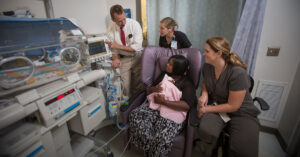
Fellows in the Newborn Critical Care Center will fulfill the clinical role of consultant or “junior attending,” with a level of responsibility between the attending physician and the senior resident. It is expected that the fellow will be intimately familiar with all infants admitted to the Newborn Critical Care Center and their care plans while on service. The fellow will become involved as a teacher and supervisor and will contribute to the care of high-risk infants without usurping the responsibilities of the pediatric house staff. UNC’s pediatric residents are the primary front-line caregivers for patients in the NCCC, responsible for direct patient care (i.e., writing orders, performing routine procedures, updating the families of patients, etc.). It is assumed that fellows in neonatal-perinatal medicine will have already had this kind of experience, and the fellowship program will not attempt to duplicate it.
In addition to clinical training in the Newborn Critical Care Center, fellows have the opportunity to enhance their clinical skills through a number of required rotations and electives, including:
- Maternal Fetal Medicine (including prenatal ultrasound, genetic counseling)
- Rex Special Care Nursery
- Cardiovascular Surgery
- ECMO (in conjunction with the UNC PICU)
- Pediatric Surgery
- Transport
Clinical Schedule
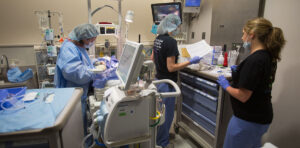
Schedules will be individualized with particular attention to the needs of each fellow and the availability of institutional resources, but will in all cases meet the requirement of the American Board of Pediatrics. In general, fellows are on clinical service for a total of 50 weeks over three years and are assigned in-house call an average of 50 days per year.
Year 1: The first year of fellowship emphasizes acquiring skills in clinical neonatology with five to six months assigned to the NCCC plus assigned in-house call shifts.
Year 2: The second year will be individualized with less emphasis on clinical neonatology and more emphasis on scholarly activities. The fellow will be expected to make significant progress on his/her chosen scholarly project and may take advantage of increased teaching opportunities. Fellows interested in clinical/epidemiology research may have the opportunity to take this year to complete an MPH at the UNC Gillings School of Global Public Health.
Year 3: The fellow’s third year will be completely customized to his/her specific goals and will additionally include at least one month as acting attending in the NICU.
A sample daily schedule in the NICU
7:00 Sign Out / Pre-round
7:50 Board Rounds / Unit “Safety Huddle”
8:00 Lecture for NCCC Housestaff / Grand Rounds (Thursday)
8:30 NICU Radiology Rounds
8:45 Work Rounds
12:00 (WEDNESDAYS) Fellow’s Conference (journal club, pathophysiology, board review)
2:30 (WEDNESDAYS) Division Meeting (research, administrative issues, M&M)
4:00 Sign out to night fellow
Weekly:
Perinatal Care Conference (with MFM, genetics, surgery, cardiology, etc.)
BPD Huddle (with OT/PT, nutrition, pharmacy, Pulmonary, nursing, etc.)
Multidisciplinary DC planning rounds (with social work, pastoral care, nursing and others)
Complex Infant Planning Session (with Supportive Care, nursing, etc.)
Educational Opportunities
Teaching Rounds
Teaching rounds are conducted daily in the Newborn Critical Care Center. Attending responsibility is shared among members of the Neonatal-Perinatal Medicine faculty.
Neonatal-Perinatal Medicine Division Meetings
The Division holds weekly meetings that include:
- Journal Club
- Research seminars by division members
- Clinical management seminars
- Business meetings to discuss administrative issues of the division and the Newborn Critical Care Center
- Quality assurance, and
- Mortality/morbidity review
Fellows’ Conference
The fellows’ conference is a weekly meeting planned by the Neonatal-Perinatal Medicine fellows, which includes members of the division and guest lecturers. Meetings cover subspecialty topics, selected topics of clinical interest, ethics, administration, statistics, and clinical study design.
X-ray Conferences
Fellows engage in daily neonatal X-ray reviews with faculty from pediatric radiology.
Perinatal Care Conference
The UNC Collaborative for Maternal and Infant Health (CMIH) and the UNC Fetal Care Center collaborate to deliver individualized, comprehensive maternal and infant health services. These services address a wide range of health issues affecting both mothers and infants, including high-risk medical conditions and developmental anomalies in fetal patients. The weekly Care Conferences are held to discuss medical findings, develop treatment plans, and provide prognoses. The team comprises experts in maternal-fetal medicine, pediatric surgery, and various pediatric surgical subspecialties. Additionally, specialists from diverse pediatric disciplines, physical medicine and rehabilitation, nursing, social work, and pastoral care work together to offer high-quality, cutting-edge therapies for high-risk pregnant women and their babies.
UNC is a leader in the Southeast in fetal myelomeningocele repair serving all of SC and NC and parts of Virginia. In addition, we offer treatment for the conditions which may require fetal intervention (EXIT, shunt placement, laser surgery, etc.) such as TTTS, fetal lung or thoracic malformations, congenital anomalies of the urinary tract, SCT, micrognathias, and others.
Pathology Conference
Approximately 20 percent of the cases reviewed at the weekly pediatric pathology conference are neonatal.
Departmental Conferences
Other departmental conferences include grand rounds, airway conference, congenital heart disease conference, ECMO conference, subspecialty conferences, and departmental teaching conferences.
Basic Science Seminars and Conferences
Opportunities in various areas are available to fellows participating in basic science research.
Core Curriculum for Pediatric Fellows
DOP sponsors a year-long series of seminars for all pediatric fellows intended to facilitate interaction among pediatric fellows and cover content areas that are common to all subspecialty residents. Seminars include a variety of pertinent topics including: Starting Out in Research, Presenting Research, How to be an Effective Teacher, How to Find a Job, Communicating with Families, and others.