Researchers in the Department of Neurology at the University of North Carolina at Chapel Hill, including Drs. Tatiana Shnitko, Alex Lin, and Ian Shih, recently shared their views in Nature Neuroscience through an article titled “Parsing autism spectrum heterogeneity through fMRI.”
Autism is known for its wide range of clinical presentations and biological complexity, making it difficult to clearly connect genetic differences with changes in brain function. In their recent article, Dr. Shih and colleagues discuss a cross-species neuroimaging effort from Alessandro Gozzi’s research team that moves the field toward a more biologically informed understanding of these complexities:
Autism is remarkably heterogeneous, posing a long-standing challenge for linking genetics to brain dynamics. A recent study by Pagani et al. identifies two principal dysconnectivity signatures across 20 mouse models of autism risk, each associated with distinct molecular pathways, and shows analogous connectivity patterns in autistic humans. These results establish a translational framework for biologically grounded fMRI phenotyping.
The Shih Lab’s overview highlights how the study moves beyond treating autism as a single, uniform condition, instead identifying distinct patterns of brain network disruption—namely hypo- and hyperconnectivity—that reflect differing underlying biological mechanisms. By identifying reproducible connectivity “signatures” across both animal models and humans, the study provides a powerful translational bridge between molecular biology and systems-level brain function.
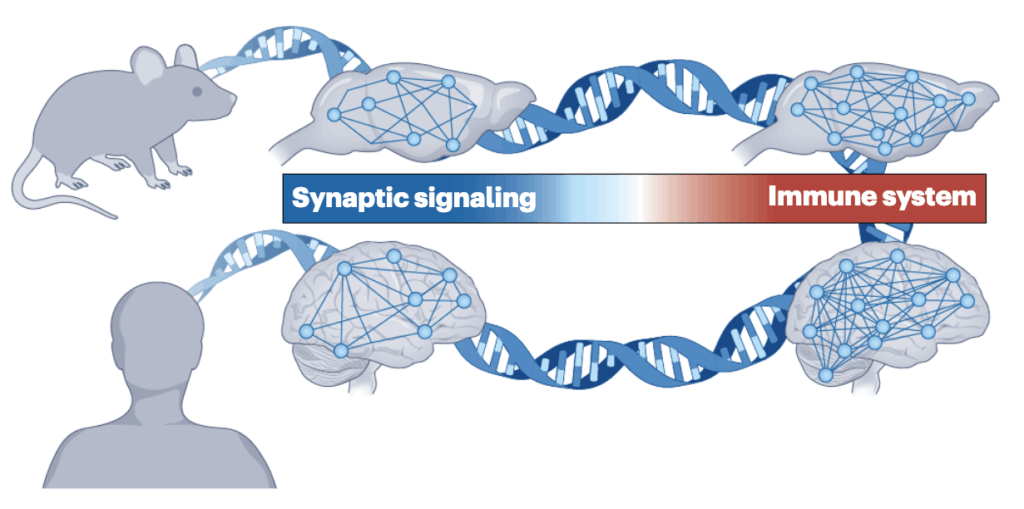
A key theme discussed in the article is the need to reconsider the long-standing excitation–inhibition (E/I) imbalance hypothesis in autism. Rather than reflecting a unidirectional shift in E/I, the newly identified hypo- and hyperconnectivity patterns suggest that different biological pathways may produce distinct forms of network dysfunction. Importantly, emerging evidence further suggests that even transient E/I perturbations during critical developmental windows may be sufficient to produce long-lasting alterations in autism-relevant brain connectivity and social behavior, and that pharmacological manipulation of E/I during development may permanently reprogram social brain circuits. At the same time, the article emphasizes that fMRI connectivity should be interpreted carefully. Because fMRI does not directly measure neuronal excitation or inhibition, large-scale connectivity patterns should not be viewed as simple direct readouts of E/I balance without additional supporting evidence.
According to the article, combining fMRI with approaches that directly measure neuronal signaling will be important for linking cellular-level processes to large-scale brain dynamic patterns. The authors also discuss the importance of studying autism at n = 1, where repeated “deep sampling” measurements from the same individual may help clarify how personalized connectivity patterns relate to molecular, developmental, and behavioral variation.
More broadly, the work challenges the common practice of averaging away inter-individual variability in brain imaging studies. Instead, variability itself may contain biologically meaningful information that could help link molecular mechanisms to large-scale brain organization across neurological and psychiatric conditions.
As the field moves toward more precise and personalized approaches, work like this represents an important shift—from broad diagnostic categories to a deeper, biology-based understanding of how the brain works.
Shih is also a member of the Biomedical Research Imaging Center, the Carolina Institute for Developmental Disabilities, and the Bowles Center for Alcohol Studies.