



 If you’ve ever joined the Department of Radiology as a faculty member or APP and found your onboarding process smoother than expected, chances are Mackenzie Cranford had something to do with it.
As a credentialing coordinator, Mackenzie works behind the scenes to ensure that every clinician is fully vetted, approved, and ready to care for patients from day one. It’s a role that rarely makes headlines—but its impact is felt in every clinic, reading room, and procedure suite.
“While I don’t help patients directly,” she says, “I help people who help people.”
That perspective drives everything she does.
The Gatekeeper of Readiness
Credentialing is more than paperwork—it’s a critical safeguard in patient care. Mackenzie helps guide providers through a two-step process: verifying their background, training, and licensure, and then working with the Medical Staff Office to ensure they are granted the precise privileges needed for their clinical work.
It doesn’t stop there. Every two years, those same providers return for recredentialing—a process that ensures their roles and responsibilities remain aligned with what they actually practice.
“It’s about keeping things accurate and safe,” she explains. “We want to make sure everyone is practicing exactly within their scope.”
Mackenzie’s reach extends beyond Radiology. She supports multiple departments—including anesthesiology, otolaryngology, and OB/GYN—as part of a small but mighty team responsible for credentialing across the entire School of Medicine.
 Finding Purpose Off the Front Lines
Mackenzie’s path to credentialing wasn’t linear. A graduate of UNC with a degree in psychology and a minor in biology, she began her career as an EMT, drawn to the immediacy and hands-on nature of patient care.
But as she reevaluated her long-term goals—and as the uncertainty of COVID-19 set in—she began looking for a role that offered both stability and a continued connection to healthcare.
She found exactly that at UNC.
“I didn’t know much about credentialing at first,” she admits. “But I loved the team, and I was excited to learn. It ended up being the perfect fit.”
Her EMT roots still matter deeply to her. She keeps her certification active, using it to volunteer and support her community in times of need—like responding to crises across North Carolina.
A Critical Role in Critical Moments
During the height of the COVID-19 pandemic, Mackenzie’s work took on new urgency. As hospitals faced overwhelming patient volumes, credentialing teams worked quickly to grant emergency privileges to incoming physicians.
“We had to get doctors here fast,” she recalls. “Being part of that process—knowing it directly impacted patient care—was incredibly meaningful.”
It’s a powerful reminder that even roles outside of direct clinical care are essential to the system as a whole.

Coach, Advocate, Role Model
When she logs off for the day, Mackenzie shifts into another role: coach.
For the past several years, she has dedicated her time to coaching youth basketball and softball for elementary-aged girls in her community. What began as a small team of ten has grown into a thriving program of more than 30 players across multiple age groups.
Her passion goes beyond the game.
“Girls’ sports can be overlooked,” she says. “I want to help change that—to give these girls opportunities, confidence, and a space to grow.”
It’s a commitment that reflects her belief in building others up, whether they’re clinicians navigating credentialing or young athletes learning teamwork and resilience.
The Person Behind the Email
As a fully remote team member, Mackenzie knows that many colleagues may only know her through email threads. But she hopes people see her as more than a name in their inbox.
“I’m here to help,” she says. “Even if it’s not technically my area, I’m always willing to figure things out.”
She prefers real conversations—phone or face-to-face whenever possible—and brings a direct, thoughtful communication style to everything she does.
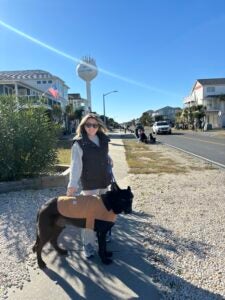 Life, Laughter, and Looking Ahead
Describing herself as “bubbly,” Mackenzie brings energy and humor to both her work and her life. She’s a self-proclaimed “life of the party,” someone who values connection, doesn’t take things too seriously, and knows how to have fun.
It’s a mindset that has carried her from a small-town upbringing in Davidson County to a role that quietly supports thousands of patient encounters across UNC Health.
And while she may not be in the exam room, her impact is unmistakable—ensuring that every provider who is, is ready, qualified, and empowered to deliver exceptional care