If you have a family member or a loved one who has been diagnosed with dementia, you most likely have concerns that go beyond the doctor’s office. We hope that the information in this section may help answer some of your questions.
Signs and symptoms of mild dementia include memory loss, confusion about the location of familiar places, taking longer than usual to accomplish normal daily tasks, trouble handling money and paying bills, poor judgment leading to bad decisions, loss of spontaneity and sense of initiative, mood and personality changes, and increased anxiety or aggression.
Signs and symptoms include increased memory loss and confusion, shortened attention span, inappropriate angry outbursts, problem recognizing family and close friends, difficulty with language (reading, writing, numbers), inability to learn new things or cope with unexpected situations, difficulty organizing thoughts and thinking logically, repetitive statements or movements, occasional muscle twitches, restlessness, agitation, anxiety, tearfulness, wandering (especially in late afternoon or at night), hallucinations, delusions, suspiciousness, paranoia, irritability, loss of impulse control, inability to carry out activities that involve multiple steps in sequence (getting dressed, making coffee, setting the table).
Signs and symptoms include weight loss, seizures, skin infections, difficulty swallowing, increased sleep, groaning, moaning or grunting, lack of bladder or bowel control.
If you feel that your condition is not related to outside causes, or that you may fall under one of the above categories, you should consider making an appointment with a physician or other medical specialist.
Caring for Someone with Dementia: the Importance of Understanding the Brain
Caring for someone with dementia can be challenging. Understanding what happens to the brain when someone develops dementia will help you manage day to day activities. Dementia affects many parts of the brain, not just parts involved in memory, but also language, movement, and behavior. Understanding that dementia involves more than a problem with memory is very important. Learning about the brain can help decrease the stress and confusion that may come from seeing your loved have difficulty with daily tasks or have behavior changes.
The National Institute of Health provides a good introduction called The Geography of Thought. This narrative provides information on what each section of the brain does related to our everyday life.
“Each cerebral hemisphere can be divided into sections, or lobes, each of which specializes in different functions. To understand each lobe and its specialty we will take a tour of the cerebral hemispheres, starting with the two frontal lobes (3), which lie directly behind the forehead. When you plan a schedule, imagine the future, or use reasoned arguments, these two lobes do much of the work. One of the ways the frontal lobes seem to do these things is by acting as short-term storage sites, allowing one idea to be kept in mind while other ideas are considered. In the rearmost portion of each frontal lobe is a motor area (4), which helps control voluntary movement. A nearby place on the left frontal lobe called Broca’s area (5) allows thoughts to be transformed into words.
When you enjoy a good meal—the taste, aroma, and texture of the food—two sections behind the frontal lobes called the parietal lobes (6) are at work. The forward parts of these lobes, just behind the motor areas, are the primary sensory areas (7). These areas receive information about temperature, taste, touch, and movement from the rest of the body. Reading and arithmetic are also functions in the repertoire of each parietal lobe.
As you look at the words and pictures on this page, two areas at the back of the brain are at work. These lobes, called the occipital lobes (8), process images from the eyes and link that information with images stored in memory. Damage to the occipital lobes can cause blindness.
The last lobes on our tour of the cerebral hemispheres are the temporal lobes (9), which lie in front of the visual areas and nest under the parietal and frontal lobes. Whether you appreciate symphonies or rock music, your brain responds through the activity of these lobes. At the top of each temporal lobe is an area responsible for receiving information from the ears. The underside of each temporal lobe plays a crucial role in forming and retrieving memories, including those associated with music. Other parts of this lobe seem to integrate memories and sensations of taste, sound, sight, and touch.”
The above information has been provided by NIH – National Institute of Neurological Disorders and Strokes.
Communicating Challenges
Communication with a mentally or physically impaired person can be a difficult and frustrating task, but good communication skills can prevent catastrophic reactions. In dealing with persons with limited physical or mental abilities, it is important to listen, speak clearly and slowly and use non-verbal communication (body language) to help convey your message.
Aphasia is a total or partial loss of the power to use or understand words. It is often the result of a stroke or other brain damage. Expressive aphasics are able to understand what you say; receptive aphasics are not. Some victims may have a bit of both kinds of the impediment. For expressive aphasics, trying to speak is like having a word “on the tip of your tongue” and not being able to call it forth. Some suggestions for communicating with individuals who have aphasia are provided below.
Be patient and allow plenty of time to communicate with a person with aphasia.
Be honest with the individual. Let him/her know if you can’t quite understand what he/she is telling you.
Ask the person how best to communicate. What techniques or devices can be used to aid communication?
Allow the aphasic to try to complete his/her thoughts and to struggle with words. Avoid being too quick to guess what the person is trying to express.
Encourage the person to write the word he/she is trying to express and read it aloud.
Use gestures or pointing to objects if helpful in supplying words or adding meaning.
A pictogram grid is sometimes used. These are useful to “fill in” answers to requests such as “I need” or “I want.” The person merely points to the appropriate picture.
Use touch to aid in concentration, to establish another avenue of communication and to offer reassurance and encouragement.
Always approach the person from the front or within his/her line of vision with no surprise appearances.
Speak in a normal tone of voice and greet the person as you would anyone else.
Face the person as you talk to him/her.
Minimize hand movements when near the other person.
Avoid a setting with a lot of sensory stimulation such as a large room where many people may be sitting or talking, a high-traffic area or a noisy place.
Maintain eye contact and smile. A frown will convey negative feelings to a person.
Be respectful of the person’s personal space and observant of his/her reaction as you move closer. Maintain a distance of 1.5′ initially.
If a person paces, walk with him/her, in step with him/her while you talk.
Use distraction if a situation looks like it may get out of hand. Examples: if the person is about to hit someone or if he/she is trying to leave the home or facility.
Use a slow, low-pitched speaking voice – the most audible to older adults.
Ask only one question at a time since more than one question will increase confusion.
Repeat key words if the person does not understand the first time around; nod and smile only if what the person said is understood.
The Importance of Self-Care
As a caregiver, the most important thing you can do for the person you are caring for is to care for yourself. Your health and wellbeing are central to being a caregiver. Scheduling time for yourself each day will enable you to be creative, resourceful, and will help decrease your frustration when things are not going as planned.
The Dementia Alliance of North Carolina estimates there are over 475,000 dementia caregivers in North Carolina. You are not alone. Most caregivers are family members of someone with dementia. Per the Centers for Disease Control and Prevention (CDC), approximately 34% of caregivers are 65 or older and another 25% are part of the “sandwich” generation who are taking care of children as well as a parent or grandparent.
Caregivers are often so busy caring for others, they neglect to pay attention to their own physical and mental health needs. The CDC reports that caregiving is associated with an increase in anxiety and depression, compromised immune function, increased reports of poor physical health and an increased risk of early death. Therefore, it is important that you continue to care for yourself by eating well, exercising, and having caregiving time out.
There are numerous studies about caregiving. We have learned that caregiving can often:
Create physical and psychological strain over extended periods of time;
Have high levels of unpredictability and uncontrollability;
Have the capacity to create secondary stress in home, work, and family relationships;
Require high levels of vigilance.
(Schulz, R, Sherwood, P.R. Physical and Mental Effects of Family Caregiving. Am J Nurs.2008 Sep; 108 (9Suppl)23-27.)
Because of these attributes of caregiving, it is important to create your “caregiving community” of both physical and informational resources. Since caregiving will involve changes to your current lifestyle, pay attention to your needs and adjusting your lifestyle to meet those needs. To do this, consider:
Sharing with family and friends your need for a “time out” and ask for a scheduled time they can assist;
Using in-home help or using local resources such as adult day care or senior center activity;
Joining a support group either in-person or online to match your scheduling needs.
The primary goal is to preserve time for meeting your needs while meeting the needs of your loved one.
We hope this information will help you recognize the importance of caring for yourself and that your health is vital to continue caring for your loved one.
Family Caregivers
Many times an individual’s primary caregiver is a family member. And whether you realize it or not, if you are providing any kind of service or action for another individual who is incapable of doing so on their own, you are a caregiver. Many family members provide care for their loved ones but do not consider themselves caregivers. If you are helping with rides to the doctor, shopping and cooking, paying the bills, grooming and bathing, housekeeping, or managing medications (just to name a few), you are absolutely a caregiver.
Just because you do not receive payment for your services does not make you any less of a care provider. And you are not alone; a recent study by the National Alliance for Caregiving and AARP found that nearly one in four households in the United States is involved in providing free care for an older adult. This number totals to about 15,000,000 caregivers looking after their family members and loved ones.
Who are family caregivers?
This is the largest group of caregivers. Most are also older, and have their own health problems. It is important that these individuals do not forget to take care of themselves, as well as their loved ones. One should also consider some outside help, such as a nurse aide, to come in your home and help you care for your loved one while you run errands or take a few days off to collect your thoughts.
The second largest group of primary caregivers is daughters. Many are married and raising children of their own. Juggling the responsibilities of caring for both your children and your parent places you in the recently evolved “sandwich generation.” There will be many more individuals joining this “sandwich generation” as our population ages.
Many women in this category help take care of an older person with dementia. They are the third largest group of family caregivers.
Although many are involved in the daily care of a parent with dementia, sons often focus on the financial, legal, and business aspects of caregiving.
Siblings may assume primary responsibility for care if they live close by. Many of these caregivers also are older and may be coping with their own health problems.
Older children may become major helpers in caring for a grandparent with dementia. Grandchildren may need extra support if their parents’ attention is heavily focused on the ill grandparent or if the grandparent with dementia lives in the family home.
Support Groups
If your life is affected in some way by dementia, whether a loved one has been recently diagnosed or you are a professional caregiver for a dementia patient, the challenges presented can take a major toll on your body physically, mentally, and emotionally. There are people out there who have been in the same place you are in and know exactly what you are going through. Millions of Americans have been affected by this disease, and the count is rising with our aging population. You are not alone.
One of the best outlets to turn to is a support group. Sometimes it is helpful to be able to sit and talk with people who understand the unique circumstances that come along with dementia. Friends and family members may be a great support, but unless they also have experience with dementia and a loved one, they may not fully understand what you are going through.
Practical Concerns
Safety Considerations
Dementia can affect areas of the brain which normally work to keep us safe; areas that provide us with reasoning and judgment and keep us from being impulsive.
Because of these brain changes, we must protect our loved ones through changes in our home environment. To determine what needs to be changed, you can ask yourself, “Could they get hurt in this situation if they do not have good reasoning skills?” or “Can our home be damaged if this occurs?”
If safety is a concern, it is best to take steps now to ensure the safety of you and your loved one.
For many older adults, having their driver’s license is a last thread of independence they have. It is not necessarily that they need the car to go somewhere every day; it’s having that option. Once they are told they can no longer drive, they can become isolated in their homes. They do not want to ask a loved one for a ride because they feel that they are a bother.
Fortunately, there are ways to have this conversation so that feelings are spared. This article offers tips and information about how to talk with your loved one about driving.
As we age, it is important to think about our goals and wishes in case we are unable to make decisions for ourselves. There are several legal and financial documents that can ensure that these wishes are carried out. These documents are especially important to complete if you or a loved one has been diagnosed with an illness that could lead to declining cognitive health, such as dementia.
Because dementia can impact our ability to think clearly, it is important to identify a person whom you trust as a proxy; a person who knows your wishes and will ensure they are followed. This is often a spouse or family member. Documents to complete include a health care and durable power of attorney, a will or living trust, permission to access bank accounts, and resuscitation considerations. It is very important that a caregiver has permission to talk with health care providers and financial institutions such as Medicare, a bank, or financial advisors. This will enable them to pay bills and manage your financial and health care needs as you directed.
Start discussions early with your loved one while everyone can still help make decisions.
Create documents that communicate health care, financial management, and end of life wishes for yourself and the people you care for, with legal advice as needed.
Review plans regularly, and update documents as circumstances change.
Put important papers in one place. Make sure a trusted family member or friend knows the location and any instructions.
Make copies of health care directives to be placed in all medical files, including information on every doctor seen.
Give permission in advance for a doctor or lawyer to talk directly with a caregiver as needed.
Reduce anxiety about funeral and burial arrangements by planning ahead.
Millions of families today are facing a difficult reality: “Mom cannot live safely in her home anymore, and I am unable to care for her myself. She needs more medical attention that I can give, but I do not want to place her in a nursing home. What do I do now?”
Many years ago, if you could not live alone in your home anymore, your only option was a nursing home. Today, there are several care options for the older adult, all with varying levels of medical care, privacy, cost, and assistance. The following compares facility types, requirements, costs and the level of care received.
Independent Living Individual residing in their own home, alone or with another individual(s), functionally and socially independent most of the time. In-home assistance may be provided by third party service agencies, church, friends or family.
Congregate Housing
Individual residing in their own apartment. Functionally and socially independent most of the time. Chronically ill, socially isolated, and frail adults are provided with 24-hour on-call assistance.
Assisted Living
Institutional setting or apartment style building. Independent apartment or private/semi-private room.
Long-term Care
Institutional setting
Continuing Care Retirement Center
Services designed to provide whatever level of support needed regardless of the individual’s needs.
Independent Living House, duplex, condominium or apartment
Congregate Housing
Mid-rise or high-rise facility, cottages. HUD 202, HUD 236, independent housing project or group home.
Assisted Living
Wing of long-term care facility or congregate housing facility, or separate apartment building or house.
Long-term Care
Intermediate care or skilled nursing facility. Free standing institutional design.
Continuing Care Retirement Center
Combination of independent cottages/apartments, congregate, assisted living and long-term care on a campus.
Independent Living None
Congregate Housing
24-hour monitoring for assistance, one or more meals daily in common dining room, various planned activities and recreation areas, laundry room for use by residents. Federal rent subsidy a likely option.
Assisted Living
24-hour monitoring and low-level medical interventions on behalf of the individual. Monitor medications, assist with ADL’s as needed, all meals provided, laundry and house-keeping provided. Could include separate wing or accommodations specifically designed for dementia care.
Long-term Care 24-hour total care. Accommodations for dementia care.
Continuing Care Retirement Center
Range from minimal or no service to 24-hour total care. Single campus setting, Resident can move from one aspect of the campus to another depending on level of care desired or needed. Exceptionally nice amenities common throughout.
Independent Living None
Congregate Housing
Federal and/or state regulations, especially if HUD property. Additional state regulations may apply.
Assisted Living
Varies greatly from state to state. General overview by a state agency. Some legislation, standards and guidelines.
Long-term Care State and Federal regulations apply. Medicare and Medicaid may be relevant to individual – additional regulations if so.
Continuing Care Retirement Center
State and federal according to level of care.
Independent Living Independence. Upkeep of home and property, property taxes, utilities, potential isolation.
Congregate Housing
Rent, utilities, taxes, some meals provided, sliding scale cost, activities, socializing with fellow residents. Loss of some privacy and independence.
Assisted Living
Level of care provided at a cost less than long-term care, but generally expensive. Meals, medication monitoring, assistance adds to monthly cost. Loss of some privacy and independence. Limitations to the extent of care available.
Long-term Care Highest level of care provided 24 hours daily by professional staff. High cost. Loss of some privacy and independence, some potential social stigma.
Continuing Care Retirement Center
Potentially the best living situations regardless of level of care needed. Loss of some privacy and independence. High initial and monthly cost based on level of care and type of residence. Can have financial complications.
J. Steven Fulks, Ph.D Barton College
Common Dementia Care Terms & Definitions
Provided below is some basic terminology as well as descriptions of professional services that are available to support of patients and caregivers:
Supervised care for older individuals in need, generally based on a sliding
pay scale. Often provide transportation to and from the site.
A legal document completed by patients to direct their medical care in
the event that they are no longer able to communicate their wishes.
Care given to a patient who does not require overnight hospitalization.
A term used to describe additional services performed related to care, such as lab work, X-ray, and anesthesia.
Area Agency on Aging; an office that coordinates various types of programs and
services, anything from Meals on Wheels to support services and educational
workshops.
A type of housing that provides services to residents based on their
individual level of need. The range would be from independent living to
intermediate care. Typically private pay, this is an attractive but costly option.
Continuing Care Retirement Center; campus-style housing option with full range of
options from independent housing cottages, congregate housing apartments,
assisted living facility, and intermediate care facility. Cost is based on level of
housing and care.
Apartment style living which provides safe and affordable housing
based on an individual’s income and medical expenses. These facilities are also
known for their government assistance program to provide supplemental income to
its residents to afford living in the facility.
a document that allows competent individuals to select
another individual to make decisions for them in the event that they become
incapacitated, including health care decisions.
Care given to dying and terminally ill individuals. Emphasis of care is on pain
management and supportive services for the patient and family.
A facility providing a level of care that is less than that of a
hospital, but greater than a level of home check-ups.
Standards of construction, protection, and occupancy that are necessary
to minimize danger to life from fire, smoke, fumes, and panic. Compliance with this
code is required for JCAHO and the Medicare and Medicaid programs.
A document generated by an individual to guide providers on desired medical
care in the case that the individual is unable to articulate his or her own wishes.
Care given to patients with chronic illnesses, and who usually require a
length of stay for longer than 30 days.
Health care that utilizes its cost of services and includes a payment
structure with a limited choice of healthcare providers. The goal is to have a system
that delivers value by giving people access to quality, cost effective healthcare.
A state administered program funded partly by the federal government
that provides healthcare services to those who meet specific income
requirements and have no insurance.
A federally funded program that provides health insurance primarily to
individuals entitled to Social Security who are age 65 or older.
One of two parts of the Medicare program that covers inpatient
hospital services and some services furnished by other healthcare providers
such as nursing homes, home health agencies, and hospice. Part A coverage is
automatically provided for individuals entitled to Medicare.
One of two parts of the Medicare program that covers patient,
physician, and medical supplier services. Part B coverage is optional and
must be paid for separately through monthly premiums.
A representative for individuals in need of healthcare, or those not
receiving proper healthcare. Acts as a “middle man” between the patient and
the healthcare providers to see that all needs are met and standards are
upheld within the facility and its workers. These individuals should be called
first if you are considering hiring a lawyer. Their services are free and just as
effective as a legal aid.
A federal law that requires health care facilities to
determine if new patients have a living will and/or durable power of
attorney for health care, and takes the patient’s wishes into consideration
when developing a treatment plan.
An organization of physicians, hospitals, and other
healthcare providers that provide services to an enrolled group for a fixed
periodic payment. PPO’s typically allow enrollees to see providers outside
the organization for an additional cost.
a formal set of activities to review and improve the quality of
services provided. Quality assurance includes quality assessment and
corrective actions to remedy any deficiencies identified in the quality of
direct patient, administrative, and support services.
A cap on cost of services used in Medicaid reimbursement.
A facility either freestanding or part of a hospital that
accepts patients in need of rehabilitation and medical care that is of a lesser
intensity than that received in a hospital.
A level of care designed for the individual who has had an acute
(sudden) event as a result of an illness, and is in need of skilled nursing or
rehabilitation, but does not need the intensive diagnostic or invasive
procedures of a hospital. The program takes an outcome-focused
interdisciplinary approach which utilizes a professional team to deliver
complex and clinical interventions.
A unit designed to provide nursing care to individuals going
from the hospital unit to either the home or a nursing facility.
Additional Resources for Patients & Caregivers
There are several informative documentary series and written literature that can help you to better understand dementia: what it is, what it looks like, and what scientists are doing about it. There are also novels written about individuals with dementia, and how it affected not only the main character’s life, but also the lives of those closest to them. Below are some highly recommended videos and readings to help you through this process as well as community resources and links to useful organizations.
Alzheimer’s Action Plan by P. Murali Doraiswamy, MD and Lisa P. Gwyther, MSW
Still Alice by Lisa Genova
Tuesdays with Morrie by Mitch Albom
When Your Loved One Has Dementia by Joy A. Glenner
The 36-Hour Day by Nancy Mace and Peter Rabins
Treasures in the Darkness: Extending the Early Stage of Lewy Body Dementia, Alzheimer’s, and Parkinson’s Disease by Pat Snyder
Melanie Bunn, RN, and consultant with the Alzheimer’s Association of North Carolina, describes home and community care resources for caregivers and health care providers.
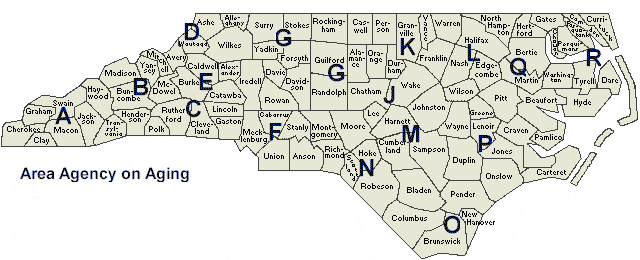
Your local Area Agency on Aging can be one of your greatest resources. If you prefer to speak with someone over the phone or meet face to face, the individuals at the AAA can be a great help for meeting your needs. They can answer questions, provide expert advice, locate services, and offer referrals to older adults and their caregivers. They can also inform you about upcoming events and information sessions.